Key UK AI Statistics and Latest Usage Trends (2026)
Artificial Intelligence is not the future. Shocking! Isn’t It? Yes, you read that right. AI isn’t the future; it is already here, impacting everything, and mostly in a positive way. And the latest UK AI statistics and usage patterns are strong evidence of this technological shift.
The adoption of AI in the UK has been rising steadily over the past few years, with over 79% of Brits admitting to using Generative AI (such as ChatGPT or other AI tools) for work.
That isn’t the only stat alone; there are even more shocking ones ahead that will make you believe how AI has started dominating as the mainstream technology in the region. So, without much delay, let’s start!
AI Adoption and Growth in the UK
The Britishers have always been embracers of new technologies and innovations, and Artificial Intelligence is no exception in this case. Here are the AI statistics related to its adoption and growth, according to Forbes:
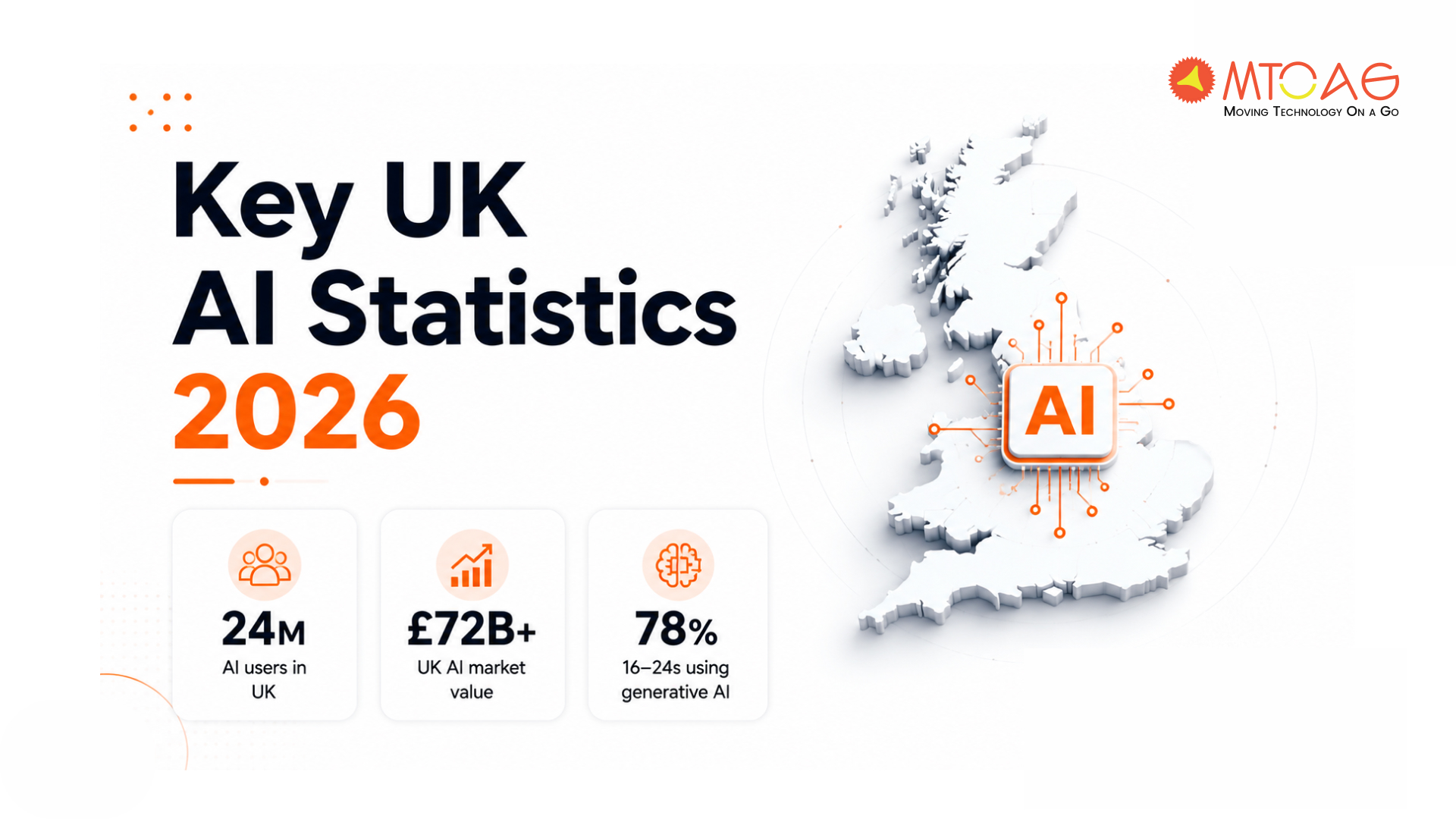
The estimated worth of AI in the UK was around £72 billion in 2024, which is expected to increase to £1 trillion by 2035.
With that, there has also been an increase in the number of AI companies by over 600% in the last decade.
68% of large-sized companies, 33% of medium abd 15% of small companies have been using at least one AI technology in their business operations.
After a 10-week trial, the UK’s biggest retail chain, Marks & Spencer, saw an 80% reduction in warehouse accidents.
Government data suggests the most commonly adopted AI solution is data management and analysis with 9%, followed by natural Language processing and generation with 8%, machine learning with 7%, AI hardware with 5%, and computer vision and image processing and generationwith 5%.
The IT and Telecommunication sector is the biggest AI adopter with 29.5% adoption rate, followed by the Legal sector with 29.2%.

AI Statistics: Impact on the Economy and Job Market
Artificial intelligence continues to be in the headlines for its significant effect on the job market. Even when it was just a buzzword, the speculations were high that AI would take over human jobs. However, the current AI stats tell a different story.
Here’s how AI is impacting the economy and job market in the UK:
The United Kingdom has an estimated AI workforce of over 3,60,00, which includes AI consultants, AI engineers, and AI developers.
Artificial Intelligence has contributed around £5.8 billion to the UK economy in the year 2023.
Britain has twice the number of AI companies and AI startups as any other European nation.
The UK’s health and social care sectors are expected to get the largest net job gains over the next two decades.
Greater London leads as the top city in AI companies, being home to over 1500 AI businesses.
The city is the most desired AI hub for AI startups in the UK, with institutions like DeepMind, Adbrain, BenevolentAI, and machine learning research groups at UCL, King's, and Imperial College.
66% of hiring managers have reported improved hiring efficiency with AI.
AI Research & Development Statistics
The United Kingdom spends significantly on AI R&D (research and development), probably more than any other European country. Every year, the UK government allocates billions in funding for AI R&D.
Here are some strong, credible stats you can use to support AI research and development in 2026:
The United Kingdom ranked 5th in the Global AI Readiness Index in 2024, and the second country in Western Europe.
Since 2014, the government has so far allocated £2.3 billion to various AI initiatives.
In 2023, the government has allocated around £1 billion in funding towards AI research and development.
The country plans to invest £900m in a supercomputer as part of its artificial Intelligence strategy that includes building its indigenous “BritGPT.”
AI Tools and Apps Usage in the UK
The latest AI statistics on usage show how the UK population is using the technology. The usage is highest among 15-24s with 67%, followed by the 35-54 age group with 49%.
Here are the AI usage statistics in the UK, according to IABUK:
22.5 million UK users have used AI tools in December 2025.
1.46 million new users have started using AI tools in the last month.
84% of the total time spent on AI tools together went to ChatGPT.
78% growth in AI usage over the last year.
Gen AI Use in the Workplace
Generative AI has integrated into the workspaces so naturally that many teams now rely extensively on it. Here are the stats showing the GenAI’s usage in the UK workplaces:
44% of the total time spent on AI tools occurs during working hours.
The top three uses of GenAI in work include generating ideas, searching for information, and creating content.
74% of those who use Gen AI for work admitted that it boosted their productivity a lot.
Top AI Apps & Tools Used in the UK
Here, we have listed down the best and the top AI tools used by the Brits:
ChatGPT (Mobile App)
chatgpt.com
openai.com
Google Gemini (Mobile App)
Microsoft Copilot (Mobile App)
DeepSeek - AI Assistant (Mobile App)
Grok (Mobile App)
ada.cx
quickcep.com
blackcrow.ai
Perplexity (Mobile App)
trueanthem.com
chatbase.co
deepseek.com
aihelp.net
Character AI (Mobile App)
perplexity.ai
claude.ai
evolv.ai
candynetwork.ai
meta.ai
goloveai.love
grok.com
quillbot.com
algolia.com
nunami.ai
ourdream.ai
PolyBuzz: Chat with AI Friends (Mobile App)
candy.ai
otter.ai
character.ai
PixVerse: AI Video Generator (Mobile App)
sora.chatgpt.com
suno.com
How is AI Used in Business Operations?
According to recent data, it is found that 36% of UK businesses use AI in marketing operations. At the same time, the Office for National Statistics reported that one in six businesses uses at least one AI technology in their workplace. Of these numbers, 70%of them use AI to improve cybersecurity and business efficiencies.
Among the UK businesses using AI, 36% of them use it for marketing operations, while 26% use it for automation. Both these purposes contribute to streamlining business efficiencies.

The latest AI statistics also show that 23% of organizations use AI for product development, while 14% use it for data analysis.
Yet, despite AI being used worldwide for risk analytics benefits, only 2% of UK businesses are using it for risk management, and 1% for predictive analytics.
What are the Challenges UK Businesses Face in implementing AI?
Artificial intelligence is no longer experimental but is being tested, piloted, and implemented across industries. Yet for many organizations, adoption remains harder than expected.
In a survey of 73,650 UK business leaders, 45% said technology adoption itself is the biggest challenge when implementing AI. Another 29% identified data privacy as their primary concern. As AI systems rely heavily on data, the pressure to protect sensitive information adds a layer of complexity that many companies are still learning to manage.
Research from YouGov and ANS highlights a similar pattern. A lack of in-house expertise continues to be the biggest barrier to AI adoption. Many businesses want to move forward, but simply do not have the technical depth to implement responsibly and at scale.

Meanwhile, large enterprises report similar friction, particularly around safeguarding private data while deploying advanced systems. The size of the organization does not eliminate the complexity. In many cases, it increases it.
Interestingly, employee training ranks much lower as a perceived challenge, cited by only 9% of respondents. Ethical considerations follow at 6%, while integration issues and cost concerns both sit at 5%.
In broader UK studies, cost is often reported as one of the top barriers to AI implementation, sometimes second only to adoption itself. AI adoption is not simply about buying tools. It requires alignment across leadership, infrastructure, compliance, and capability.
Conclusion
The above-listed AI statistics prove that the technology has moved beyond the experimentation stage in the UK and is now embedded across industries, institutions, and everyday workflows. Investment is accelerating, adoption is expanding across company sizes, and usage spans from marketing and automation to product development and cybersecurity. The workforce is growing alongside it, supported by sustained Government funding and a strong research ecosystem.
At the same time, implementation gaps, skills shortages, and governance pressures continue to influence how effectively businesses scale their initiatives. The opportunity is clear, but structured execution remains critical. For organizations seeking practical AI strategy, secure development, and scalable implementation, Mtoag Technologies can help them with focused AI consulting and end-to-end development expertise.
FAQs
Is the UK Leading in AI?
The UK is considered one of the global leaders in AI, ranking 5th in the Global AI Readiness Index (2024). It has the highest number of AI startups in Europe and is home to major research hubs in London, Cambridge, and Oxford.
What is the UK's AI Strategy?
The UK’s National AI Strategy focuses on long-term investment in research, talent development, infrastructure, and responsible governance. It includes billions in public funding, support for AI innovation, and plans to strengthen computing capacity and sovereign AI capabilities.
Will the UK Be an AI Superpower?
The UK has strong foundations to become an AI superpower, backed by research Institutions, private investment, and policy support. However, long-term leadership will depend on sustained funding, talent retention, infrastructure expansion, and responsible implementation.
Is AI in Demand in the UK?
Yes, AI talent and solutions are in high demand across sectors, including IT, finance, healthcare, retail, and legal services. UK businesses are actively adopting AI for automation, analytics, cybersecurity, and productivity improvement, driving steady workforce growth.