Adaptive Software Development 101: Phases, Benefits, and Basics
Software development projects often get complicated as they gradually move into crucial stages. With each change in product requirements, shift in priorities and customer feedback, the technical challenges seem bigger than you even expected. And teams that stick to rigid development approaches often struggle to work on these changes mid-project. But Adaptive software development (ASD) seems to be solving these struggles with a totally different approach that treats changes as a part of the development process instead of a disruption.
Just like Rapid Application Development (RAD), ASD also focuses on short iterations or continuous and quicker adjustments. But does it stack up with other development methodologies? And most importantly, what makes Adaptive Software Development stand out above all of them?
Through this guide, we will explain the basics of adaptive software development, how it works, its core phases, its benefits, and how it competes with other development methodologies.
What is Adaptive Software Development (ASD)?
Adaptive software development (ASD) refers to a development methodology that is designed specifically for projects with flexible requirements, priorities, and evolving technical understanding.
Project managers Jim Highsmith and Sam Bayer first coined the term in the early 1990s when the application development industry started to thrive. It was explicitly designed around projects where it is not possible to predict every requirement upfront.
Unlike other development approaches that keep very little room for mid-project changes, ASD takes uncertainty as part of the software development lifecycle (SDLC). And it is clearly reflected through its three crucial phases:
Speculation
Collaboration
Learning
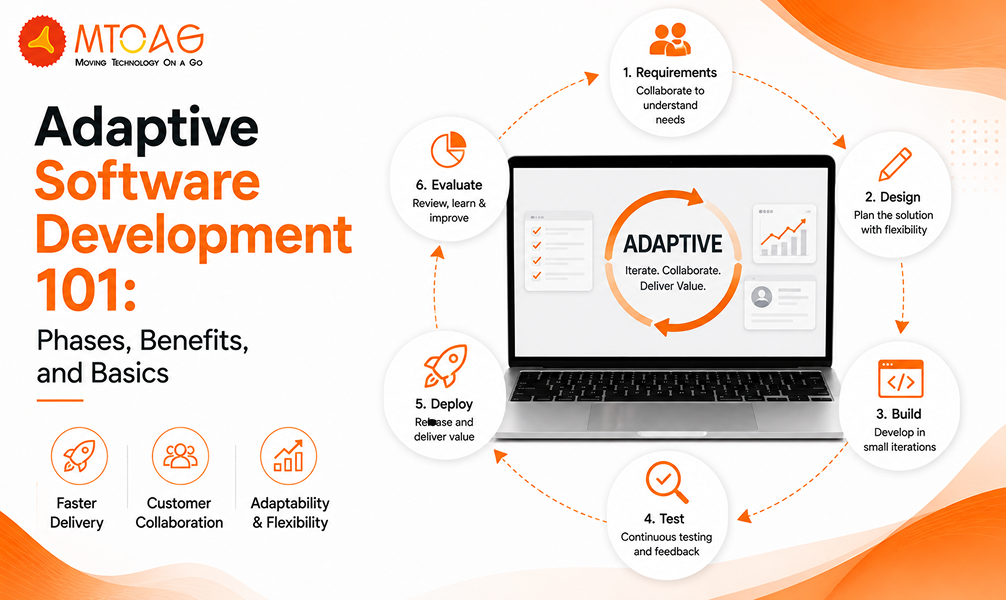
These three stages of the adaptive software development approach help teams make future assumptions, gather feedback, build accordingly and refine the project direction with each change. The “adaptive” clearly indicates what this approach is all about.
Although ASD doesn’t follow a fixed path, planning still makes a big part of the approach. However, the plans are usually treated as assumptions rather than commitments. The development teams use stakeholder reviews, feedback, and testing reports to create the next cycle of work. The progress isn’t measured through milestone completion but in terms of usability, improved decision-making and validated learning.
Core Characteristics of Adaptive Software Development
Now that we are done with understanding the basics of adaptive software development, let’s move forward to look at its characteristics or core principles.
Collaborative Learning
Adaptive software development puts a massive focus on great collaboration between the development team and stakeholders. The approach emphasizes continuous learning and its importance for adapting to evolving project requirements. Stakeholders collaborate openly and share insights, helping improve the overall software development process.
Continuous Adaptation
Adaptive software development’s USP remains the continuous adaptation to ever-changing requirements. Instead of seeing changes as a roadblock, ASD embrace them as a necessary aspect of the entire development lifecycle. With that being said, the team remain flexible for changes and adjust tier strategies to align with the evolving requirements. This flexibility is specifically critical for sectors like Banking & Finance, where there is continuous evolution in market conditions and regulatory requirements.
Iterative Development
Adaptive software development emphasizes iterative development cycles, which allow room for developers to have regular inspection and adaptation according to the project. With each iteration and feedback, there comes an opportunity for software to be more refined and enhanced according to what the client actually needs for their users. This approach is particularly beneficial for custom business applications that need frequent upgrades with changing user requirements.
Risk Management
Recognizing the uncertainty as part of the software development, ASD actually puts a strong focus on risk management. The development team can identify and address the risk throughout each phase of the project development, which enables them for proactive risk mitigation and better decision making.
3 Crucial Phases of Adaptive Software Development
The adaptive software development approach runs through three crucial stages that primarily include
1. Speculation
This is the first and foremost stage of the adaptive software development approach, where decisions related to project planning and commencement are made. The plan could include the crucial information like project requirements, customer mission statement, add-on features and user needs, which are necessary for defining release cycle sets for the project.
2. Collaboration
This is the middle layer of ASD phases and probably the most challenging part, too. Although the phase promotes collaboration and communication between stakeholders, it also emphasizes individuality, as it is crucial for creative thinking. Team members working together should trust each other to
Assists in resentment
Criticize without any personal favours
Work efficiently
Communicate issues to find an effective resolution
3. Learning
The developers work through multiple iterations of design, coding and testing cycles, remaining in the continuous loop of learning. These iterative cycles provide a valuable opportunity for teams to acquire knowledge and increase their level of project understanding through a series of minor mistakes and correcting them.
Advantages of Adaptive Software Development
This software development approach brings plenty of benefits to each and every stakeholder of the project, which mainly include
1. Faster Time-to-Market
ASD focuses on delivering working software in iterative cycles rather than waiting for a complete development, which means faster deployment. The early version of the software can generate revenue, get user feedback and gain a competitive advantage, giving a window for improvement while the product is still in production.
2. Low Risk of Project Failure
The first phase of ASD allows the development team to acknowledge the uncertainty, and when it is combined with the learning phase, it lowers the risk of project failure. Catching and correcting the issues early will also help save the costs that may arise in the future. Like in the waterfall methodology, where the project reaches the end of the development cycle only to discover a fundamental mismatch with users, which may lead to failure, ASD structurally prevents that.
3. Higher Quality Software
Each ASD iteration includes development, testing, review and refinement. And when testing and QA experts are involved in the ASD cycle rather than the post-development testing phase, errors are found and fixed early, leading to a better-quality software solution.
4. Better Stakeholder Alignment
The continuous collaboration between stakeholders during the collaboration phase means they already know what’s going on in the project. As a result, there would be no conflict between expectations and deliverables. Clients engaged at every stage of the project feel more satisfied with the results and have a strong sense of ownership over the product.
5. Improves Team Morale
Adaptive software development allows development teams to make decisions with every iteration with genuine autonomy. The accountability helps improve team morale, attract top talent and reduce turnover. Developers who can see the impact of their work try to give their best every time.
6. Scalability
Unlike some popular methodologies that work at scale, ASD work uniformly for both small-scale and large enterprise-grade software development programs. The phases scale up with multiple parallel tracks with one shared project alignment.
7. Continuous Delivery of Business Value
With every progressive iteration, the working increment offers real business value, not just documentation. This means the Return on Investment (RoI) in software development starts from day one, not after the final release.
Adaptive Software Development vs Other Methodologies
When Should You Use an Adaptive Software Development Approach?
Adaptive Software Development is undoubtedly the best approach for software development, but it works even better in three situations, which are as follows:
High Uncertainty
When project requirements are unclear or likely to change. For example, the client may not yet know:
Who the target users are
What features will users need most
What regulatory requirements may apply
Which technology stack will be the best fit
ASD allows teams to learn, adapt, and refine the product as new information becomes available.
Tight Timelines
If the client needs to launch the software quickly before their competitors do so, ASD helps by:
Delivering working software in short iterations
Prioritizing the most valuable features first
Reducing delays caused by lengthy Upfront planning
Allowing improvements to continue after the initial release
Cross-Disciplinary Teams
When people from different specialties need to work closely together. ASD works well for teams that include:
Developers
Designers
Business analysts
Domain experts
Quality assurance professionals
Stakeholders and clients
The collaborative nature of ASD enables stakeholders to have frequent communication, faster & better decision-making and effective integration of diverse expertise throughout the project.
Conclusion
Adaptive software development is something most of the modern software development projects may relate to. However, it is not a one-size-fits-all solution. The best way to leverage it is to find the right balance between its strengths and weaknesses.
ASD work best with active stakeholder involvement and a skilled development team like Mtoag Technologies. We understand the importance of finding the right balance. Our experienced software engineers carefully assess the requirements, project size and user access to decide on the best methodology, whether it's ASD, Agile or Kanban. We believe in customizing our approach according to each project.
FAQs
What is Adaptive Software Used for?
Adaptive Software Development is used to build software projects where requirements are uncertain or likely to change. It helps teams release working software in small stages, gather feedback regularly, and improve the product throughout the development process.
What is the Meaning of ASD in Computers?
In software development, ASD stands for Adaptive Software Development. It is a development approach that focuses on flexibility, continuous learning, and collaboration instead of following a fixed plan from start to finish.
What are the 4 Adaptive Strategies?
Adaptive approaches commonly rely on four key strategies, which mainly include continuous learning, frequent collaboration, iterative development, and responding to change. Together, these help teams improve the software based on feedback rather than sticking to rigid plans.
What is a Key Challenge in Adaptive Software Development?
The biggest challenges is managing changing requirements without affecting project timelines or budgets. Teams also need strong communication and active stakeholder involvement to make quick decisions and keep the project moving forward.