What Industries Benefit Most from Custom AI Solutions?
AI automation has taken no time to become the operational backbone for several industries. Across many major sectors, custom AI solutions have started dominating and are emerging as the top choice for enterprises. With evolving technology, they have moved beyond just automating repetitive tasks; they can now analyze context, uncover hidden insights, and even execute multi-step workflows that once took hours of manual effort.
The industrial shift towards AI automation is not theoretical but highly statistical. According to MarketsandMarkets, the global AI market was valued at $601.93 billion in 2026, which is projected to reach $3.6 trillion by the Early 2030s, growing at a CAGR of 29%. The adoption rate of AI is rising among emerging sectors, with healthcare, education, manufacturing, IT and logistics industries taking the most advantage of it.
With such a huge adoption, the question for most enterprises has shifted from whether to adopt AI to how to get started. If you are also exploring how AI is transforming industries, this article will help you better understand the topic. We will feature the top 8 industries that benefit the most from custom AI solutions.
How can Custom AI Solutions Help Industries?
Custom AI automation software can help enterprises with several crucial facets of their business requirement, even covering those left out by off-the-shelf solutions.
Here’s how it can benefit businesses across industries:
1. Maximize ROI
While we are still stuck on AI efficiency and operational power, enterprises first think about ROI (return on investment). In this series, custom AI solutions are the best bet for boosting ROI. These solutions are exclusively developed around business needs and don’t demand compromise, which we usually see in ready-made software solutions.
Off-the-shelf solutions usually operate under a standardized framework that may not suit every business, and as a result, some processes can slow down, resources can be wasted, and growth opportunities can be missed. Investing in custom AI automation means you can use your own data, have your own workflows around actual processes and automate tasks that once took human intervention.
2. Automate Operations and Improve Efficiency
The best and most common use case of AI for business is workflow automation. The repeated tasks that take a lot of effort and time can be automatically done by AI. It can even cut down on human mistakes, speed up operations, automate customer support via AI chatbots, and streamline inventory management and supply chain logistics.
As these repetitive tasks are handled by AI, you can focus on using business resources on much harder and more creative tasks.
3. Scalability
AI automation has turned out to be a boon for many businesses. As said, custom AI agents and models can take over repetitive tasks, which not only reduces errors made by humans But also makes every part of the business more efficient. This applies especially to customer service, logistics and inventory management.
As AI supports regular business tasks, the intelligence of human employees can be spent on other valuable and more core business tasks. They don’t have to do tedious work, such as data entry, scheduling appointments, and finding new leads.
4. Data-Driven Decision-Making
In today’s ever-evolving world, data is everything, and custom AI models leverage the best data. As you already limit your data to your workflows, you get highly predictable trends and behaviours and don’t have to deal with guesses.
AI models can predict future trends using past information and customer behaviour. With data-driven insights by your Side, you can strengthen your marketing efforts, manage inventory more efficiently and even change pricing strategies.
5. Cost Efficiency
Investing in custom AI development takes a significant budget, but it is a long-term investment that can deliver greater flexibility, scalability, and business value. By automating Manual tasks, handling customer queries and processing client orders, there will be a need for fewer human workers, which saves costs on hiring staff. It even lets current employees focus on more core tasks rather than looping over that tedious work.
Industry-wise Use-cases of AI Automation
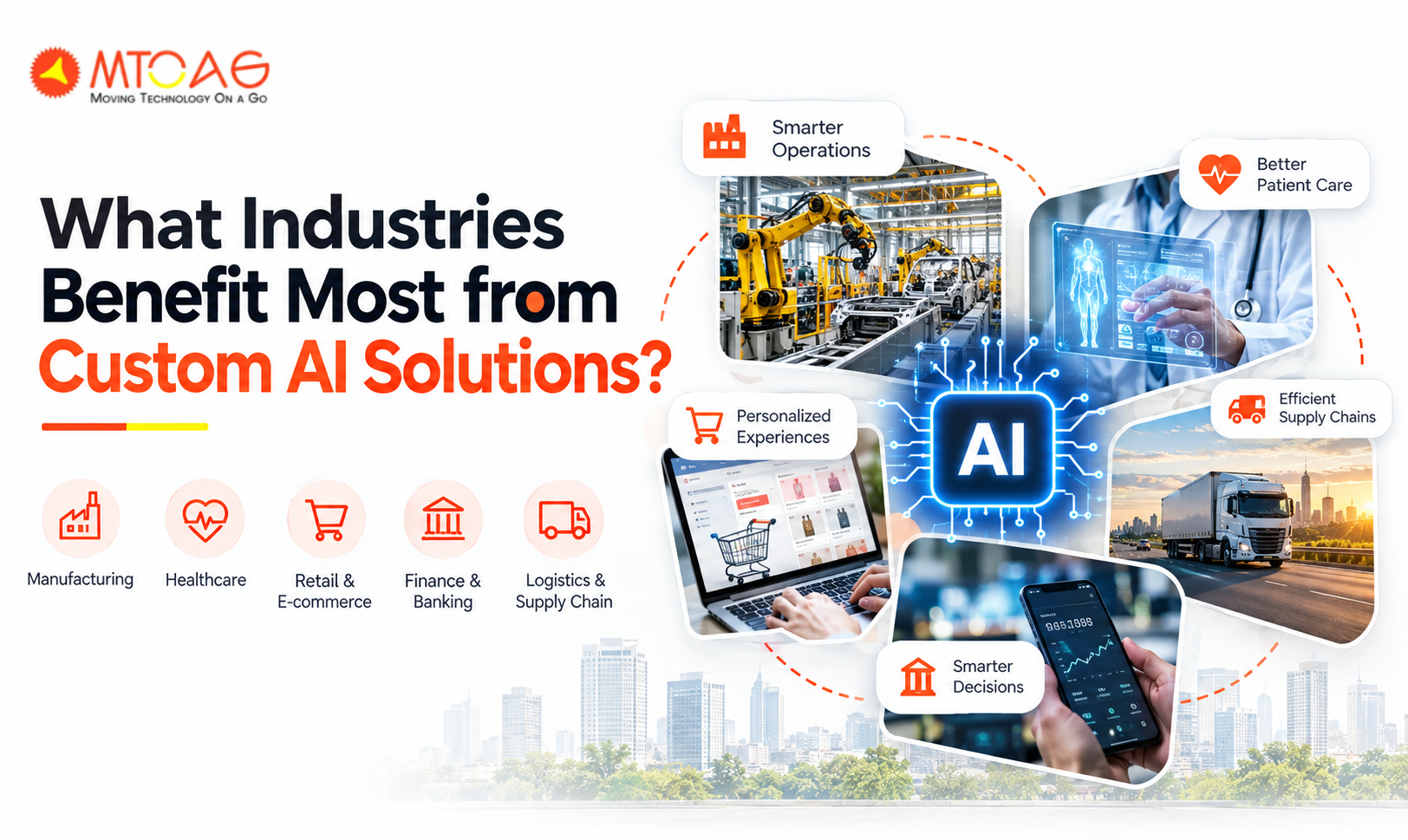
AI automation indeed has plenty of advantages for many businesses, but its use cases are different for each industry. So, here’s the list of industries that benefit most from custom AI solutions:
1. Healthcare
Healthcare institutions deal with massive amounts of patient data and daily administrative work. AI automation helps reduce this load without having any influence on how doctors provide care.
Hospitals and clinics can invest in AI solutions for appointment scheduling, patient reminders, billing, report management, and follow-ups. At the same time, it helps them organize patient records and send precise information to the right staff.
For example, a patient books an online appointment, and the system automatically confirms the booking, sends a reminder for the visit and updates the appointment. This helps staff to spend less time on this tedious task and focus more on delivering better services.
2. Banking and Finance
Just like hospitals, the banking & finance sectors handle thousands of transactions deals with customer queries and documents every day. Even a minor task may take a significant amount of time from a human employee.
AI automation can efficiently handle such tasks with ease, including checking documents, processing routine requests, sending payment reminders, sorting customer queries, and preparing regular reports. It even has a sharp eye on fraud transactions and flags unusual activity for the concerned team to review. For customers, this can mean faster responses and fewer delays when completing common banking tasks.
3. Retail and E-commerce
Retail businesses have to deal with numerous tasks every day, which may include managing products, orders, customers, payments, and deliveries at the same time. Meanwhile, AI solutions can help manage these tasks with ease. For instance, whenever a customer places an order, the system automatically processes it, updates the stock, confirms the stock, notifies the warehouse and sends delivery updates directly to them without needing any human intervention.
At the same time, businesses can even use automation to answer common user queries, send reminders for abandoned carts, manage product information, and follow up with customers after a purchase.
4. Manufacturing
The manufacturing sector involves various connected processes, which mainly include raw material purchasing, production and delivery. Even a minor delay in one area can affect the entire operational cycle. Automation can help track inventory, monitor production schedules, manage purchase orders, and update teams when stock levels are low.
At the same time, it automatically collects information from machines and identifies signs of equipment problems before they lead to major delays. In this sector, timing is everything, and better control over these routine processes can help reduce downtime and keep production moving.
5. Logistics and Transportation
The supply chain and logistics sectors deal with regular deliveries, routes, drivers, vehicles, orders and customer updates. However, managing everything single-handedly as the business grows turns out to be a bit difficult.
However, AI-driven automation can help assign deliveries, track shipments, send delivery updates, manage driver schedules, and organize transport records. It can even help businesses spot delays and inform customers about changes in delivery times. This makes the entire process easier to track from the packaging to final delivery.
6. Real Estate
Real estate businesses receive bulk of enquiries from sellers, buyers, tenants, and investors. Trying to manage everything manually may lead to missed chances and delayed responses. However, AI in real estate can help capture new leads, send property details, schedule property visits, and remind sales teams to follow up.
Businesses can even organize property listings and match customer requirements with suitable properties. Therefore, businesses get more time to manage conversations and property deals rather than continuously updating records and sending routine messages.
7. Education
Schools, colleges, coaching centres and online learning platforms- every other education institution have many repetitive tasks, including student registration, attendance, fee reminders, class schedules, assignments, and communication with parents or students.
However, AI in education can help automate reminders, organize student information, manage routine enquiries, and keep students updated about classes or deadlines. At the same time, admins and teachers can spend less time on maintaining repetitive records, which results in a smoother day-to-day experience for both students and teachers.
8. Insurance
Insurance companies, just like the banking sector, deal with massive amounts of data on policies, claims, documents and customer requests. Many of these processes involve repeated paperwork and background check reports.
However, AI automation can help Insurance companies collect claim details, sort documents, send policy reminders, update customers about claim status, and route cases to the right team. It can even help employees find relevant policy information faster, which reduces delays and makes routine insurance services easier for customers to access.
Conclusion
Custom AI solutions are not limited to a few sectors; they have found applications in crucial industries, such as healthcare and banking, as well as retail, manufacturing, logistics, education, real estate, and insurance. Businesses across industries are using them to reduce manual work, improve efficiency, control costs, and make better decisions. The real value of AI development is not in building solutions but in developing them around specific business needs.
For businesses planning their next step, the focus should be on finding the right processes to automate and choosing technology that can grow with the business. Mtoag Technologies helps businesses build custom AI solutions around their workflows, goals, and industry requirements, making AI automation more practical and useful for long-term growth.
FAQs
How is AI Used in Industries?
AI is used to automate routine tasks, analyze large amounts of data, improve customer service, predict demand, detect problems, support decision-making, and manage complex workflows across different business operations.
Which Industry Uses AI Most?
Healthcare, banking, retail, manufacturing, and technology are among the biggest users of AI. Banking and technology companies use it extensively for automation, fraud detection, data analysis, customer support, and business operations.
What are 5 Benefits of AI?
Five major benefits of AI include faster operations, lower costs, fewer human errors, better decision-making, and improved customer experiences. It also helps businesses handle large workloads and scale operations more efficiently.