Mobile Banking App Development: Process, Compliance & Cost Guide
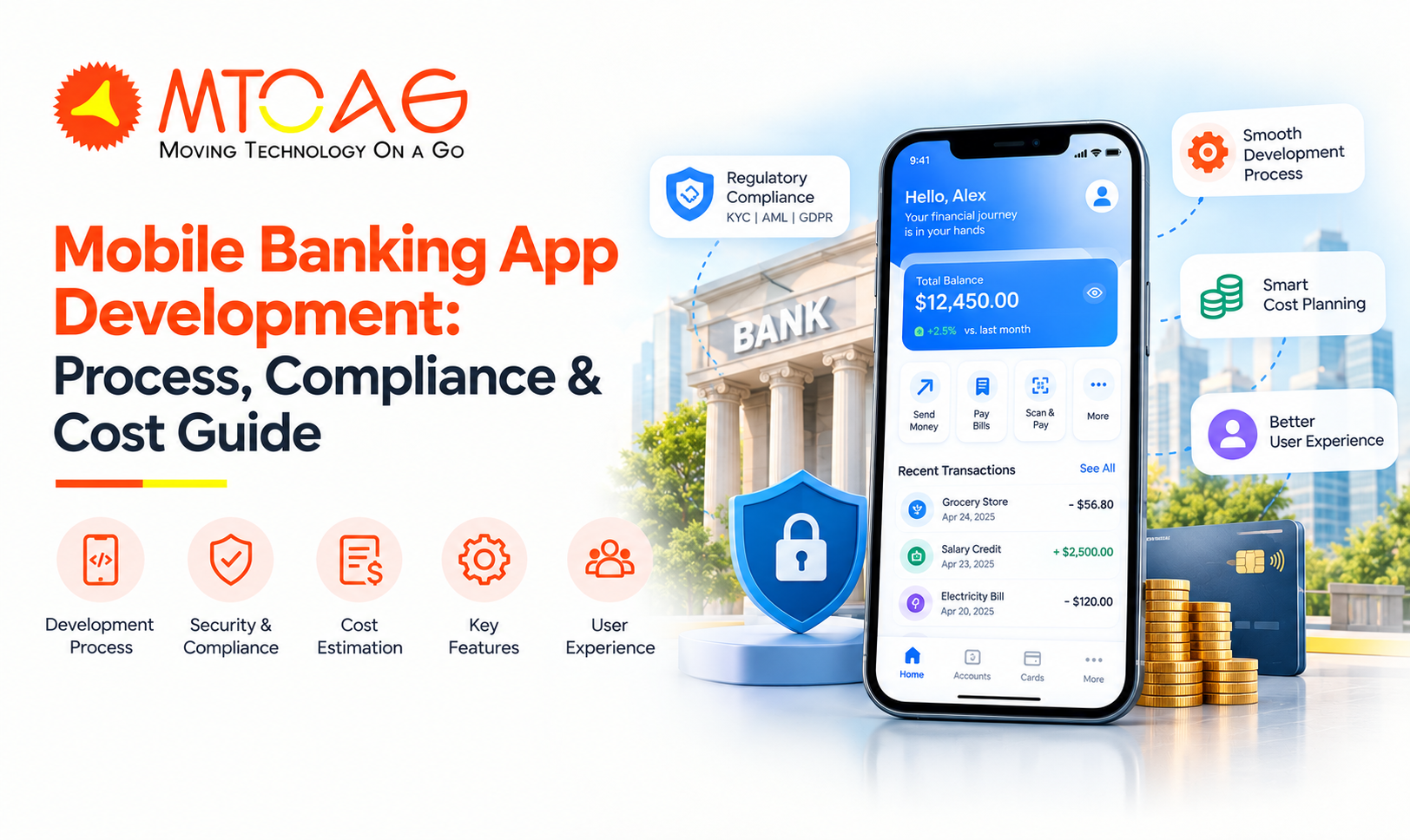
Gone are the days when people had to visit banks frequently to get everything done physically, whether it was about withdrawing cash, initiating a transfer, or getting an account statement. But the time has changed now, and so has the technology around banking. Mobile banking apps have taken over all the tasks that once required an in-person presence at bank premises. With that being said, banking institutions are steadily moving towards digitalization and increasingly investing in mobile banking app development services.
You will be surprised to learn that over 54% of Americans use mobile banking apps or other online methods as their preferred banking method. With growing user expectations, banking and financial institutions are left with no other option than to offer mobile-first banking services.
However, mobile banking app development is not about developing an app, deploying it, and being all set. As banking is a highly compliance-sensitive sector, building such apps requires careful planning, working on a strict compliance checklist, robust security measures, and most importantly, a user experience that is easy to understand and navigate.
Key Market Statistics on Digital Banking Platforms
The worldwide digital banking market was valued at $37.5 billion in 2025, which is expected to reach $155.4 billion by 2033, growing at a CAGR of 19.8%. (Source: Grand View Research)
Around 46.2% of people use digital banking services weekly, while 19% use them daily. (Source: Self.Inc)
Mobile banking app usage is high across all ages, with 67% among Millennials, followed by Gen Z with 63% and Baby Boomers with 38%. (Source: ABA.com)
95% of US banking consumers rate their digital and mobile banking app experience as either excellent or good. (Source: ABA.com)
Understanding the Different Types of Mobile Banking Apps
Banking apps are broadly categorized based on their operations and services. The three most popular banking app types in the US include —
Retail Banking Apps (for regular customers)
Retail banking apps are specifically for regular users who handle daily financial activities like depositing, withdrawing, balance checks, money transfers and bill payments. These apps are simple and convenient for retail users and make their banking experience easy. The features of retail banking apps include
Account management
Mobile cheque deposit
Credit cards
Investment tracking
Debit card controls
Money transfers
Bill payments
Savings accounts
Loans
Corporate Banking Apps (for businesses)
Corporate or enterprise banking apps are built particularly to serve large-scale corporations, businesses and enterprises with a need for bulk transactions, financial operations and payroll management. These apps provide more personalized control, advanced functionalities and better tools for handling finances. The core functionalities of corporate banking apps include
Multi-user access
Business accounts
Invoice payments
Payroll management
Treasury management
Approval workflows
Accounting integrations
Cash flow monitoring
Neo-banking / Digital-Only Apps
Neo-banking apps have quickly garnered the attention of both millennial and Gen Z users. They operate completely online without any physical branches. With a focus on digital-first banking, these banking software solutions offer modern interfaces, faster services and innovative features. The must-have features for Neo-banks include
Digital onboarding
AI customer support
Instant virtual cards
Real-time spending insights
Budget management
Core Features of a Mobile Banking App
A mobile banking app without customer-centric features stands a very low chance of adoption. Although not every feature-studded app guarantees success, the right combination of functionalities and features is critical in driving customer engagement and long-term retention.
Here are the core features every mobile banking app requires:
Account and Transaction Management
The first feature of a mobile banking app should be the convenience of checking account balances, downloading statements, browsing transaction history and managing multiple accounts in one place. However, this feature requires an advanced API integration layer for pulling and synchronizing data in real-time.
Payments and Transfers
A banking app should offer consumers the convenience of doing domestic & international transfers, bill payments, P2P transfers and recurring payment management. However, the complex challenge here stands in terms of payment network integrations with SWIFT, SEPA, ACH, or other local rails. Each payment service provider has their own set of rules, reconciliation requirements and failure modes.
Security and Authentication
The security features required for an online banking platform include multi-factor authentication, biometric login, fraud detection, device binding and session management. However, the challenge at this stage is layering them all correctly. For instance, the layering should be so accurate that there should be biometrics at the device level, MFA for high-risk actions and fraud scoring that doesn’t affect legitimate transactions.
Mobile-First Features
If users are accessing the banking services through a mobile phone, then the first priority should be to offer the mobile-first experience. Make sure your app is integrated with features such as mobile cheque deposit, push notifications, card controls and contactless payment integration. All these features together make the user experience more accessible and great.
Smart Features
It's 2027 already, and nobody wants an outdated app that does the basic transfers or balance checks. Integrate the smart AI features into your apps, such as budgeting tools, spending analytics, saving goals and AI-powered customer support. Make sure your app has features to categorize transactions, offer insights into spending, and also an AI-powered chatbot that can resolve queries without having to connect with a human executive.
Investment & Wealth Management
Integrating investment and wealth management features expands the banking apps’ functionality beyond offering just basic services. The app should have advanced features, such as stock trading capabilities, robo-advisory integration, cryptocurrency buying/selling, automated portfolio rebalancing, investment performance analytics, dividend tracking, and retirement planning tools, etc.
Regulatory Compliance Checklist for Mobile Banking App Development
To develop and launch a mobile banking app in the USA, you first need to comply with the required federal and state regulatory bodies. Here’s a compliance checklist for mobile banking app development in the US:
Federal Financial Institutions Examination Council (FFIEC): The regulatory body is responsible for overarching cybersecurity standards. You must use the Cybersecurity Assessment Tool (CAT) and follow the Information Security Booklet to check your app’s risk level.
Gramm-Leach-Bliley Act (GLBA): The act is regularly monitored by the Federal Trade Commission (FTC), and it makes it mandatory for an app to have a clear Privacy Notice explaining how it collects and uses the data. You first need to implement an Information Security Program.
USA PATRIOT Act & Bank Secrecy Act (BSA): The acts are strictly enforced by FinCEN And mandate that online banking platforms feature Know Your Customer (KYC) workflows. This means the app needs to collect and verify the user's name, Date of Birth, and Social Security Number (SSN).
Office of Foreign Assets Control (OFAC): This act mandates that mobile banking apps must integrate automated screening to block accounts and transactions for individuals on the US government’s sanctions list.
Federal Reserve, OCC, and FDIC: This is specifically for traditional banking institutions or fintech apps partnering with local banks. This act mandates that mobile applications strictly adhere to Third-Party Risk Management (TPRM) guidelines issued by the Regulators.
Step-wise Mobile Banking App Development Process
This section will explain the typical mobile banking app development process to help you understand and empower you to make better decisions at each phase.
Phase 1: Blueprint & Architecture
Before development or coding starts, the first thing should be a real, working plan. The development team sits with the client to understand the business goals and the target user’s needs. This stage requires deep market research and user persona mapping.
Feature Mapping: Sorting out the core and must-have features for the app, including instant transfers, balance checks, biometric authentication, etc.
Tech Stack Selection: Choose the best and most secure technology for the app development (for instance, you can choose Swift/Kotlin for a native iOS or Android app, or Flutter for cross-platform apps).
Compliance Design: Create a secure banking system that strictly complies with PCI-DSS, GDPR and other regional banking laws.
Phase 2: Secure UI/UX Engineering
Banking apps must be secure and intuitive at the same time. This design phase creates a visual roadmap for both the development team and the business.
Frictionless Wireframing: Map out the logical user experience journeys that help minimize the steps for minor tasks, such as balance checking or sending money.
Accessible Visuals: Make sure the app has clean initiative elements, layouts and clear typography so users never feel lost.
Security Integration: The UI must be designed in a way to mask sensitive data and handle session timeouts accurately.
Phase 3: Development & Heavy Encryption
This is the most critical part of the entire mobile banking app development process. In this stage, developers build the frontend, keeping in mind the seamless user experience while integrating the backend using advanced technologies.
API Connection: The developer connects the app interface with the core banking systems, third-party payment gateways, and service providers.
Data Lockdown: The development team implement end-to-end encryption for data safety, whether it is in transit or at rest.
Code Obfuscation: The development team makes sure that the source code remains protected from tampering and reverse engineering.
Phase 4: Rigorous Testing & Deployment
Modern banking apps have zero margin for error, as they handle millions of dollars and, most importantly, a massive set of sensitive data. Therefore, mobile banking apps go through a rigorous testing cycle before being launched for the broader public.
Penetration Testing: This testing stage simulates cyberattacks to find loopholes or any hidden security vulnerabilities.
Functional QA: This testing stage verifies every calculation, transaction and edge case to make sure they work flawlessly.
Store Submission: This stage involves publishing the apps to the App Store and Google Play Store following the strict compliance guidelines.
How Much Does Mobile Banking App Development Cost?
The overall development cost for a mobile banking app in the US typically ranges between $45,000 and $600,000+. However, the mid-range standard consumer apps cost between $90,000 and $220,000.
As banking and fintech apps require robust data security, strict compliance and complex backend development, the final cost depends on the project’s exact scope.
Here’s a table showing the average cost of mobile banking apps based on complexity level:
Conclusion
Mobile banking app development has moved significantly from the stage of just offering user experiences and basic banking services on smartphones. The development requires compliance planning, secure architecture, core banking integration and reliable backend systems that add value to both the business and the users.
If you have any questions or want any technical assistance, you can reach out to our expert development team at Mtoag Technologies. We offer end-to-end online banking app development services, integrated with a cutting-edge tech stack, intuitive design and top-notch security.
FAQs
How to Develop a Mobile Banking App?
Start by identifying User needs and regulatory requirements, then design an intuitive interface, develop secure core banking features, integrate payment services, thoroughly test the app, and regularly update it with new features and security improvements.
What is the Role of Mobile Banking Apps?
Mobile banking apps let users manage their finances anytime by checking Balances, transferring money, paying bills, and accessing banking services securely without visiting a physical branch, improving both convenience and efficiency.
How Long Does It Take to Develop a Mobile Banking App?
A mobile banking app typically takes 6 to 12 months to develop, depending on the number of features, security requirements, third-party integrations, compliance standards, and the complexity of the overall project.