Enterprise AI: What Is It & How It Helps Businesses?
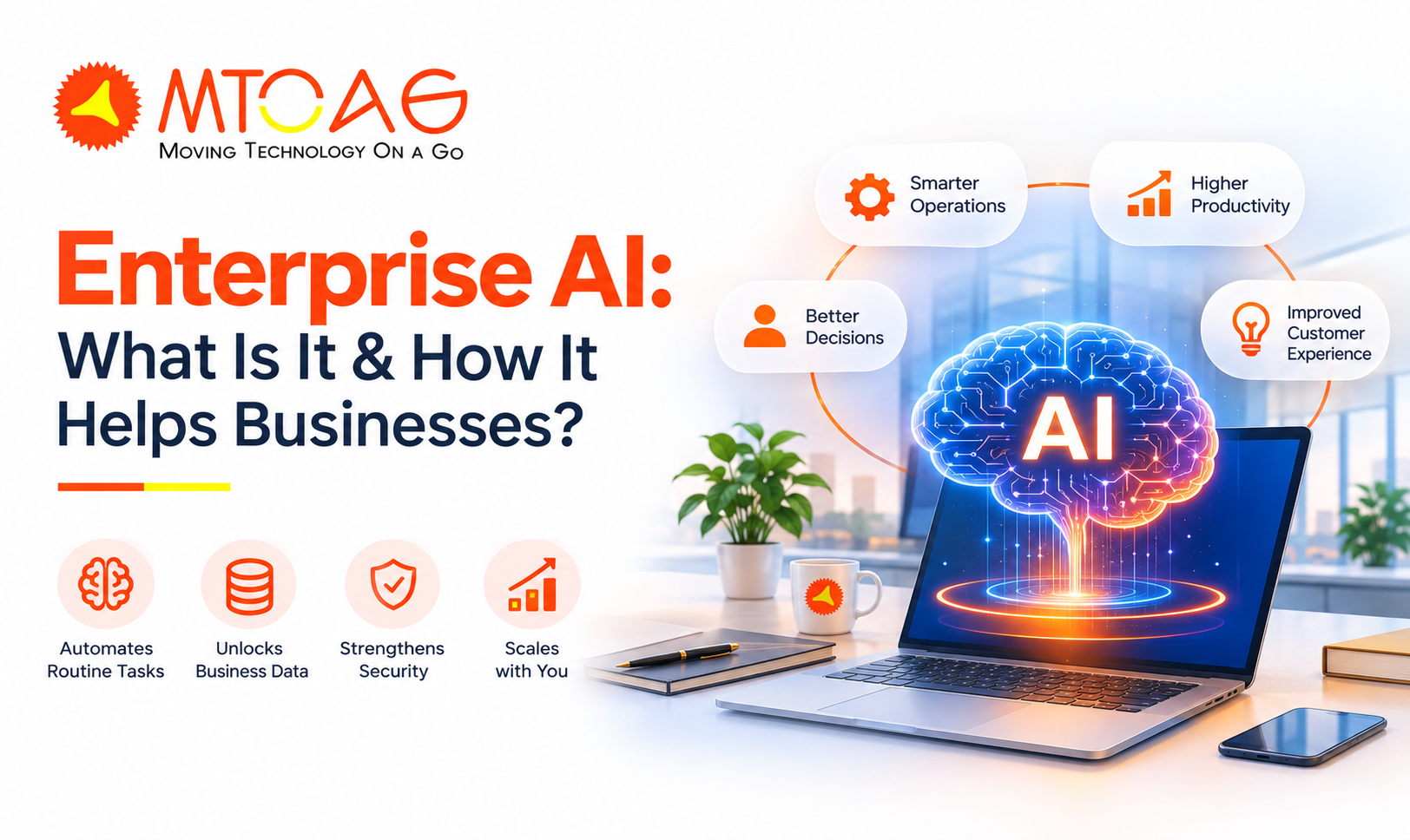
Just like cricketers need state-of-the-art kit to gain an advantage and win the game, businesses need enterprise AI to get better, improve workflows, and stay in the game. It is an emerging technology that trains on large sets of data so that it can learn, reason and perform a variety of tasks on its own.
According to the CIO, 90% of businesses are using enterprise AI across their departments to help automate tasks, innovate, and analyze trends to improve user experiences and boost productivity.
Through this article, we will look deeply into the basics of enterprise AI, its benefits and how it is helping businesses in their growth journey. So, let’s get started!
Market Analysis: The Impact of Enterprise AI in Numbers
The worldwide enterprise AI market is worth approximately $42 billion in 2026, which is expected to reach $55.2 billion at a CAGR of 37.6% for the period. (Source: Grand View Research)
Around 44% of enterprises reported scaling their AI investments across multiple departments, rising from 38% the previous year. (Source: McKinsey)
Organizations spending every $1 on AI initiatives reported an average return of $3.50 in business value. (Source: OpenAI)
1 in 5 companies, approximately 21%, has established a solid framework for autonomous AI agents and tool governance. (Source: Deloitte)
What is Enterprise AI?
Enterprise AI means using artificial intelligence across an organization's business processes, software, data, and operations. It is broader than using a normal AI chatbot. A GenAI tool may help a person write an email or answer a question. But an enterprise AI system can be connected to a company's internal data, applications, databases, and workflows.
For example, imagine a company receives thousands of customer support requests every month. An enterprise AI solution can read incoming requests, identify their type, search the company's internal knowledge base, summarize the customer's issue, and prepare a response for a support employee.
The employee can then review the information and respond to the customer. This is one important difference. Enterprise AI is not about using an AI model, but putting AI into real business processes in a controlled way.
An enterprise AI environment can include machine learning, generative AI, predictive analytics, automation, large language models, and AI agents. Because these systems may work with sensitive company information, enterprise AI also needs stronger security, access controls, integration, monitoring, and governance.
Top Use Cases of Enterprise AI
Enterprise AI have found its application across almost every business department. However, the right use case depends on the company's processes, available data, existing software, and business goals.
Customer Service and Support
Customer support is one of the strongest areas for AI implementation for a long time. An AI system can classify incoming support requests and send them to the right team. It can also search internal documents to find relevant information for support employees.
For example, when a customer reports a billing problem, AI can identify the issue, find the relevant billing policy, summarize the customer's previous interactions, and prepare a draft response.
The support employee can review the draft before sending it. AI can also summarize long customer conversations. This helps the next employee understand the issue without reading the entire conversation.
Sales and Marketing
Sales teams deal with large amounts of customer and market information. Enterprise AI can help organize and analyze this information. AI can review customer activity, summarize account information, identify possible leads, and help sales teams understand customer interactions.
Marketing teams can also use AI to study campaign performance and customer behaviour. It can help create different versions of marketing content or personalize communication based on customer information.
For example, a sales employee preparing for a customer meeting could use an AI system to summarize previous emails, recent purchases, support requests, and other approved information in one place.
Finance and Accounting
Finance teams usually work with invoices, financial documents, reports, and large datasets. AI can help process invoices, extract information from financial documents, identify unusual transactions, and support forecasting.
For example, an AI system can read an invoice and extract the supplier name, invoice number, amount, and date. That information can then be sent into an existing accounting workflow. AI can also help finance teams compare large amounts of financial information and prepare reports for review.
Human Resources
HR departments manage employee questions, documents, job descriptions, policies, and workforce information. An enterprise AI system can help employees find answers to common questions about company policies and benefits. It can also help HR teams process documents and prepare job descriptions.
For example, instead of asking an HR employee a basic question about leave policy, an employee could use an internal AI assistant that searches approved company information and provides the relevant answer.
AI can also support workforce analysis by helping HR teams work with large amounts of approved employee data.
Software Development
Software development is another major area for enterprise AI. AI tools can help developers write code, explain existing code, prepare documentation, identify possible bugs, create test cases, and search internal software knowledge.
For example, a developer working on an old application may need to understand how a particular function works. An internal AI system can search approved code and documentation and explain the relevant information.
This can reduce the time developers spend searching through large codebases. However, AI-generated code still needs testing and human review. Developers should not just copy and paste the code but review it before using it
Supply Chain and Operations
Businesses can also use AI to improve operational planning. Enterprise AI can analyze demand patterns, inventory data, logistics information, and equipment data. It can support demand forecasting, inventory planning, route planning, and predictive maintenance.
For example, a manufacturer could use AI to analyze machine data and identify patterns that may indicate a maintenance issue. The system can then alert the operations team so the equipment can be checked before the problem becomes more serious.
Understanding Enterprise AI Architecture
Enterprise AI architecture is a combination of AI models, business data, applications, users, and security controls that work together. However, the architecture is usually centred around the company’s goals and needs.
A typical architecture can include several important layers.
Data Layer
The data layer contains the information that an AI system needs to work with. This can include databases, business documents, data warehouses, APIs, customer records, product information, and other approved enterprise data. Data pipelines may be used to move and prepare information for AI applications.
AI and Model Layer
This layer contains the AI models used by the Application. Depending on the business requirement, a company may use a machine learning model, a generative AI model, or another type of AI system. For example, one application may use a model to forecast demand, while another may use a large language model to understand and generate text.
Application Layer
The application layer is where employees or customers interact with AI features. AI may appear inside a customer service application, enterprise software, mobile application, internal portal, or another business system. For example, a customer support employee may see an AI-generated conversation summary directly inside the company's support application.
Integration Layer
AI usually needs to communicate with existing software through APIs, databases, cloud services, and other integrations. An AI application may need to retrieve information from a CRM, update an approved record, or send information to another business application.
Security and Governance Layer
Security and governance run simultaneously across the entire AI environment. These controls can include user authentication, access permissions, data protection, activity monitoring, compliance controls, and policies for AI use. They help determine who can access an AI system, what information it can access, and what actions it is allowed to perform.
Benefits of Enterprise AI for Businesses
Enterprise AI solves real business problems. Simply adding an AI feature to existing software does not automatically create business value.
Automates Repetitive Work
Many business processes contain repetitive tasks. AI can help process documents, classify requests, summarize information, extract data, and perform other routine activities. This gives employees more time for work that requires communication, judgment, planning, or problem-solving.
Improves Access to Business Information
Large organizations often have information spread across databases, documents, applications, and internal knowledge bases. Enterprise AI can make this information easier to find and understand. For example, an employee could ask a question in normal language and receive an answer based on approved internal information instead of manually searching through multiple documents.
Supports Faster Decision-Making
AI can analyze large datasets much faster than a person can manually review them. It can identify patterns, compare information, prepare summaries, and provide insights that support business decisions. However, AI output should not automatically be treated as the final decision. Important decisions may still require human judgment and additional checks.
Improves Customer Experiences
AI can help businesses understand customer needs and respond faster. It can support personalized recommendations, faster customer service, and quicker access to customer information. For example, a support employee with an AI-generated customer summary may understand a customer's problem faster and provide a more relevant response.
Supports Scalable Business Operations
As a business grows, the amount of data, customer requests, documents, and internal processes also grows. AI can help organizations manage higher volumes without requiring every task to be handled manually. The system can support employees as workloads increase while keeping people involved where their judgment is needed.
Top Challenges in Implementing AI for Enterprises
Implementing AI in an enterprise is more complicated than connecting an AI model to an application. Here are some of the top challenges businesses often face:
Data Privacy and Security
Enterprise systems may contain customer information, financial records, employee data, business documents, and other sensitive information. Companies need to control which AI systems can access this information and which users can access the systems.
Integration and Infrastructure
Many companies already use several business applications, databases, APIs, cloud platforms, and older systems. Connecting a new AI solution with these systems can take significant planning. Legacy applications may not have modern APIs, while different systems may store information in different formats. Therefore, the AI solution needs to fit into the existing technology environment rather than operate as an isolated application.
AI Governance and Compliance
Companies also need clear rules for using AI. These rules can cover model usage, data access, human oversight, monitoring, transparency, compliance, AI-generated content, and autonomous AI agents.
For example, an AI agent may be allowed to read information from a system but not change important records without human approval. Governance helps define these boundaries before the system is widely deployed.
How to Implement Enterprise AI Solutions?
A successful AI implementation should start with a business problem rather than the desire to use AI simply because it is popular. Here’s how you can do it effectively:
Identify a Clear Business Problem
Start with a specific workflow, bottleneck, or business requirement. For example, a company may have a problem with slow invoice processing or a large number of repetitive customer requests. A clear problem makes it easier to decide whether AI is actually suitable.
Assess Data and Existing Systems
Before building anything, check the available data and existing technology. The organization should understand where the data is stored, whether it is accurate, who can access it, and how it can be used. Make sure to review the existing applications and infrastructure.
Select the Right AI Approach
Different problems require different AI approaches. A company may use traditional machine learning for prediction, generative AI for content and language tasks, retrieval-based systems for searching internal information, or AI agents for workflows involving several steps. Sometimes more than one approach is needed.
Build and Integrate the Solution
The AI solution should connect with the applications and workflows employees already use. This may involve APIs, databases, cloud services, enterprise software, and user interfaces. The aim is to make AI useful within the existing process rather than creating another disconnected system.
Establish Enterprise AI Governance
Before wider deployment, organizations should establish clear controls. These can include access permissions, data policies, security controls, monitoring, human approval requirements, and rules for AI agents. The controls should match the level of risk involved in the particular AI application.
Test Before Scaling
An AI system should be tested before being introduced across the organization. Testing should look at accuracy, reliability, security, performance, and actual business usefulness. It is also important to test how the system behaves when information is incomplete or when it receives unexpected input.
Monitor and Improve
It is important to understand that AI models can change, business data can change, software systems can change, and user expectations can change. Regular monitoring helps organizations identify problems and improve the system over time.
Conclusion
Enterprise AI is not a single product or technology. It can include AI models, business data, applications, integrations, cloud infrastructure, security controls, and governance processes working together. Businesses have already started embracing it across customer service, finance, HR, software development, sales, and operations to handle practical problems.
At the same time, successful AI implementation requires better data quality, system integration, security, governance, testing, and ongoing monitoring. Businesses looking to build or implement enterprise AI solutions can get expert help from technology providers such as Mtoag Technologies to plan and develop solutions around their specific business requirements. We have been in the software development industry since 2009 and are redefining what’s possible in the AI ecosystem.
FAQs
What is the Best Enterprise AI?
The right enterprise AI solution depends on the company's goals, data, security requirements, existing technology, budget, scalability needs, and specific use case. Businesses should also consider integration, governance, model performance, support, and long-term maintenance when selecting an enterprise AI platform.
What is the Difference Between Generative AI and Enterprise AI?
Generative AI refers to AI systems that can create content such as text, code, images, audio, or other outputs. Enterprise AI is a broader concept that covers how artificial intelligence is used and managed within an organization. Generative AI can therefore be one part of an enterprise AI strategy.
What is Enterprise Software Development?
Enterprise software development is the process of building software for organizational use. It can include business applications, internal systems, workflows, databases, integrations, security controls, and data management. Enterprise AI can be added to these systems to support specific business processes, automation, analysis, or employee workflows.