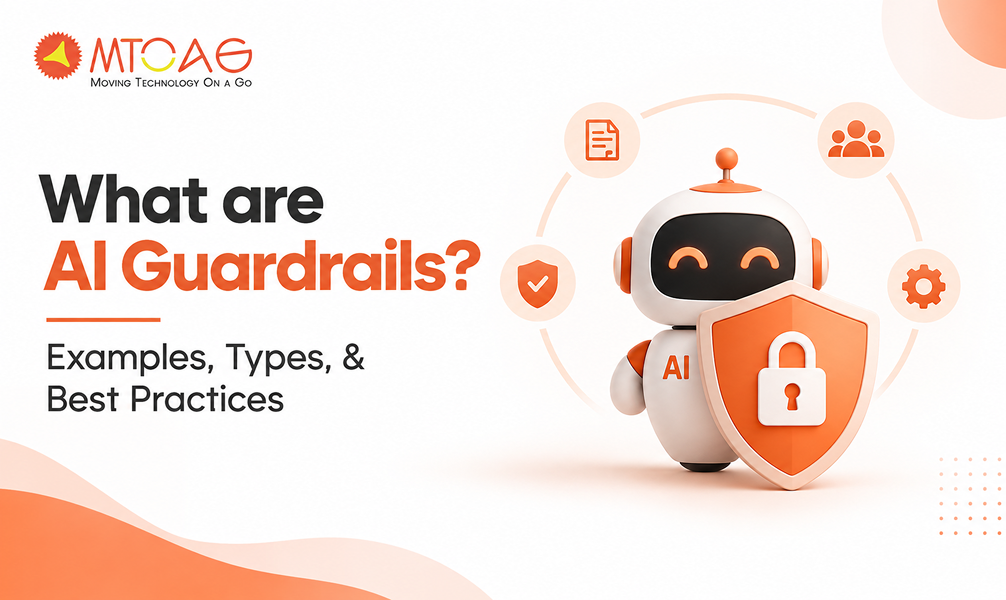
What are AI Guardrails? Examples, Types, & Best Practices
The wild rush to adopt Artificial Intelligence (AI) across sectors is intensifying with each passing day. While the shift promises greater efficiency and production, it is also introducing new challenges for businesses to cope with inaccurate, biased, or unpredictable outputs from Large Language Models (LLMs). The worst part is that most businesses don’t realize the issues until they start impacting their operations, workflow and customer experiences. However, AI guardrails seem to be solving these challenges to a great extent.
Unlike traditional systems, LLMs use statistical patterns to generate responses instead of a predefined framework and rules. This means they are at high risk of generating inaccurate information, unethical answers, and even perpetuating social discrimination. AI guardrails work as safety checks to make sure the LLM models operate in accordance with defined boundaries.
But what exactly are AI guardrails? How do they work? More importantly, how can they help businesses deploy AI applications with greater safety? Let us explain the basics of AI guardrails, their different types, practical examples, and the best practices for implementing them effectively to make understand the concept better.
Key Statistics to Consider
The worldwide AI Guardrails market was valued at around $0.7 billion in 2024, but is expected to grow with a CAGR of 65.4% to reach $109.9 billion by 2034. (Source: Market.US)
Large-scale enterprises hold about 75.55 of the total AI Guardrails market share in 2024. (Source: Market.US)
By industry, the BFSI sector remains the largest adopter, with over 30.2% of the overall market share. (Source: Market.US)
What are AI Guardrails?
AI Guardrails can be defined as a set of defined rules or safety measures intended to make sure the AI systems work safely, responsibly, in accordance with regulatory requirements and within boundaries set by the Business.
AI guardrails are an umbrella term covering technical controls, policies and monitoring mechanisms that govern how an AI system generates responses in the real world.
For instance, AI guardrails work exactly like the physical guardrails you often see on motorways. They help keep the vehicle on track and even prevent it from veering off course.
In a similar context, AI guardrails help AI applications, whether AI chatbots, AI agents, or any automated tool, deliver accurate responses while protecting them against vulnerabilities, such as sensitive data exposure or harmful content. They can improve response quality, protect sensitive information, block harmful or inappropriate content, and ensure the system behaves according to an organization's policies and compliance requirements.
However, they don’t guarantee perfect outcomes. Just like physical guardrails don’t guarantee that accidents will not happen, AI guardrails don’t entirely eliminate the risk of unfair, defiant and unethical responses.
What are the Main Types of AI Guardrails?
There are three main types of AI guardrails, and each one covers a different risk. Each system layer ethically, operationally and technically works together to catch issues before AI gives a final response.
Let’s understand each in detail:
Ethical AI Guardrails
Ethical guardrails make sure the response remains fair, unbiased and aligned with real human values. They structurely addresses the risk related to AI systems reproducing and amplifying the biases based on historical training data. This is something that can not be caught without active monitoring.
For instance, an AI agent in customer service can systematically neglect specific customer segments based on training data patterns. The data carried the patterns forward. Ethical AI guardrails address and correct the behaviour through model safety, continuous monitoring and alignment checks.
Operational Guardrails
Operational AI guardrails convert the organizational, legal and regulatory compliance standards into functional enforcement protocols within the AI pipeline. Industry regulations, such as GDPR, HIPAA, or other internal policies, don’t automatically execute themselves.
These operational guardrails ensure the integration of the scope of author ized Agent actions, preserve complete audit trails and enforce mandatory human intervention for critical decisions with AI agentic systems. Ultimately, this layer of AI guardrails offers legal and compliance departments the assurance needed to approve AI integration in the industry.
Technical Guardrails
Technical Guardrails are the last implementation layer. It builds the mechanism directly into the AI pipeline to inspect inputs, validate responses and prevent unsafe processing. These may include schema validation, prompt injection detection, output formatting, and content filtering rules.
This guardrail type covers author ization To verify the AI agent’s permission to call specific tools or access data resources before it acts. This layer of LLM guardrails is the final safety check on AI model behaviour.
Industry-wise Applications of AI Guardrails
The requirements for AI guardrails are different across industries. The right control for the healthcare sector won’t work for the BFSI sector.
So, here are some industry-wise applications of AI guardrails:
Healthcare
Healthcare is one of the most strictly regulated and compliant industries, and the use of AI here should be well governed. For instance, an AI agent managing clinical workflows may face strict regulatory requirements for accessing patient data and treatment recommendations.
In such a case, the operational guardrails layer enforces HIPAA compliance, while ethical guardrails identify how the patient information is being surfaced, prioritized, and routed within the workflows. In this type of deployment, a well-governed AI agent is required to surface the relevant case history to doctors without storing the protected health information outside the approved boundaries.
Financial Services
Financial services are another highly regulated industry that forces every stakeholder to perform within the defined limits. However, AI processing transactions, communicating with customers and assessing credit often carries a high chance of fiduciary and regulatory risk. Technical guardrails can validate the responses against the pre-set compliance rules before they even reach the customers.
However, it may require human review for final decisions above the defined thresholds. These may include a fraud flag, loan approval or a large-amount transaction. This ensures that the consequential decisions go through human review instead of relying fully autonomous. It gives a clear audit of what the AI agent evaluated, why it did so and what it has recommended.
Legal and Professional Services
AI agents working in legal and other professional services operate in high-stakes environments. They often draft legal documents, summarize confidential case files, and flag compliance issues. One output mistake and that leads straight to material consequences. The technical layer enforces citation accuracy while flagging unverifiable claims. Meanwhile, operational guardrails route the outputs with legal implications through a human reviewer before the final response.
Best Practices to Implement AI Guardrails Effectively
The implementation of AI guardrails works as a defence, with slower evaluator layers and deterministic checks. No single control is able to catch every failure mode. Let’s discuss the best practices to implement AI guardrails effectively across business processes.
Input and Output Validation at Every Stage
The AI systems run rule-based filters, such as keyword matching, regex, and schema validation, in the first milliseconds. The surviving requests go to machine learning classifiers that strictly scan responses for hallucinated claims, PII leakage and policy violations. Make sure to check and validate the input and output at every stage.
Keep a Human-in-the-loop Review for High-stakes Decisions
The AI model may propose recommendations or make predictions, but they need human approval. The automation keeps on moving routinely while human review stays sharp on the potentially risky cases.
Run Testing and Red-teaming
MITRE ATLAS (Adversarial Threat Landscape for Artificial-Intelligence Systems) features the critical tactics, methods and real-world AI attack case studies to learn from. Meanwhile, use Microsoft PyRIT, which can automate single-turn and multi-turn probes in a few hours.
Continuously Monitor Guardrails
AI guardrails are not a one-time implementation. As AI models, user behaviour and regulatory requirements evolve with time, guardrails must be continuously monitored and refined to remain effective. Make sure to track key metrics such as policy violations, false positives, response accuracy and user feedback to identify gaps in the existing safeguards. Meanwhile, regular audits, performance reviews and updates to guardrail rules help businesses adapt to emerging risks, maintain compliance and ensure AI systems continue to operate safely and reliably over time.
Conclusion
AI guardrails have proven their worth as a security essential for building advanced AI systems to make sure they remain secure, reliable and aligned with the business objectives. These guardrails can hel business reduce the risk of inaccurate responses, compliance violations, and sensitive data exposure while improving the overall output quality, on the other hand.
However, the effectiveness greatly depends on regular testing, continuous monitoring and human oversight to keep up with the advanced AI models and regulations.
If you are planning to build safe and secure AI-powered applications, AI agents or enterprise automation solutions, Mtoag Technologies is worth considering. Our AI development expert and adept engineers build secure, scalable and compliance-ready AI solutions with military-grade guardrails, helping businesses to embrace AI automation with long-term reliability.
FAQs
What is a Guardrail in AI?
An AI guardrail is a set of rules, policies and technical controls that keep AI systems operating within predefined boundaries. It helps improve response quality, protect sensitive data, reduce harmful outputs and ensure compliance with business and regulatory requirements.
What is an Example of a Guardrail in AI?
A common example of an AI guardrail is a content filter that blocks the AI model from generating harmful, offensive or confidential information. Another example is restricting an AI agent from accessing sensitive business data without proper authorization.
Why Does AI Need Guardrails?
AI models generate responses based on patterns instead of fixed rules, which increases the risk of inaccurate or unsafe outputs. AI guardrails help reduce these risks by validating Responses, enforcing policies and keeping AI behaviour aligned with business objectives.
What are the Benefits of AI Guardrails?
AI guardrails help businesses improve response accuracy, protect sensitive information, reduce compliance risks and prevent harmful outputs. They also increase trust in AI systems by ensuring They operate safely, consistently and within organizational and regulatory boundaries.
What are Common AI Guardrail Failures?
Some of the common AI guardrail failures include false positives, missed policy violations, prompt injection attacks, hallucinated responses and incomplete data protection. These issues usually occur when guardrails are outdated, poorly configured or not continuously monitored and tested.
How to Test LLM Guardrails?
LLM guardrails can be tested through red-teaming, adversarial prompt testing and continuous monitoring. Businesses should evaluate how the AI system handles unsafe prompts, policy violations and edge cases while regularly updating guardrails based on the test results.