The Ultimate Guide to Developing a Grocery Delivery App Like Getir
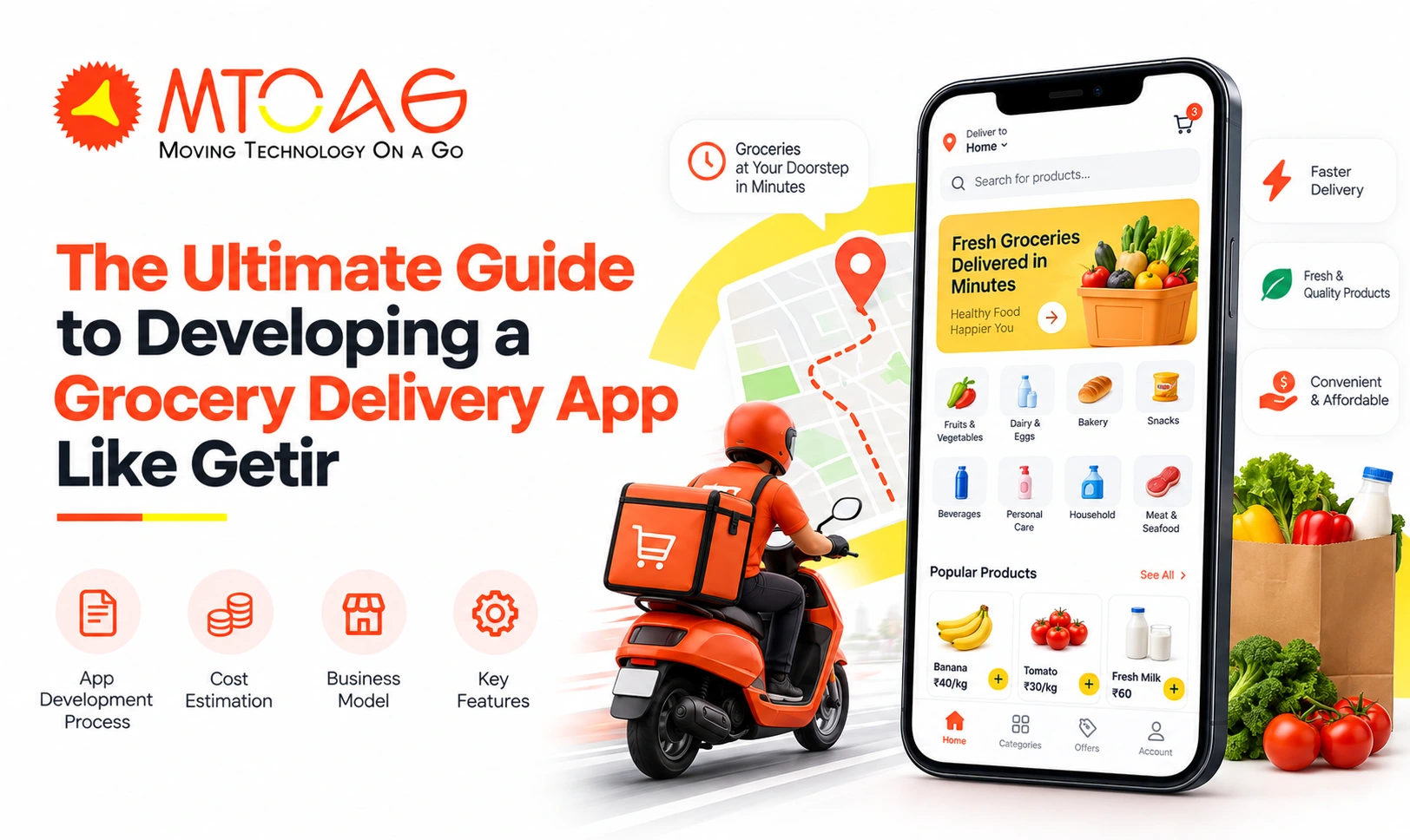
The Q-commerce industry in the UK is on the rise, with consumers embracing fast grocery delivery apps for daily necessities. Meanwhile, apps like Getir, Zapp and Gopuff are dominating the market and setting new expectations for speed and convenience. Since businesses are jumping in to capitalize on the increasing demand for rapid delivery, developing a grocery delivery app like Getir can prove to be the best bet in 2027.
What makes the UK’s grocery delivery market particularly attractive to businesses is the gap between the users' demand and local supply. Although these top grocery apps dominate nearly 70% of the entire market, there is still a massive 30% up for grabs.
If you are planning to develop an app like Getir in the UK, this guide will help you understand the process, required features, typical cost of the project, and business model of Getir, so you can decide whether it is profitable to invest in such an initiative or not.
Stats and Trends in the UK’s Grocery Delivery Market
Here, we present some crucial statistics on the UK’s online grocery market, according to Market Data Forecast.
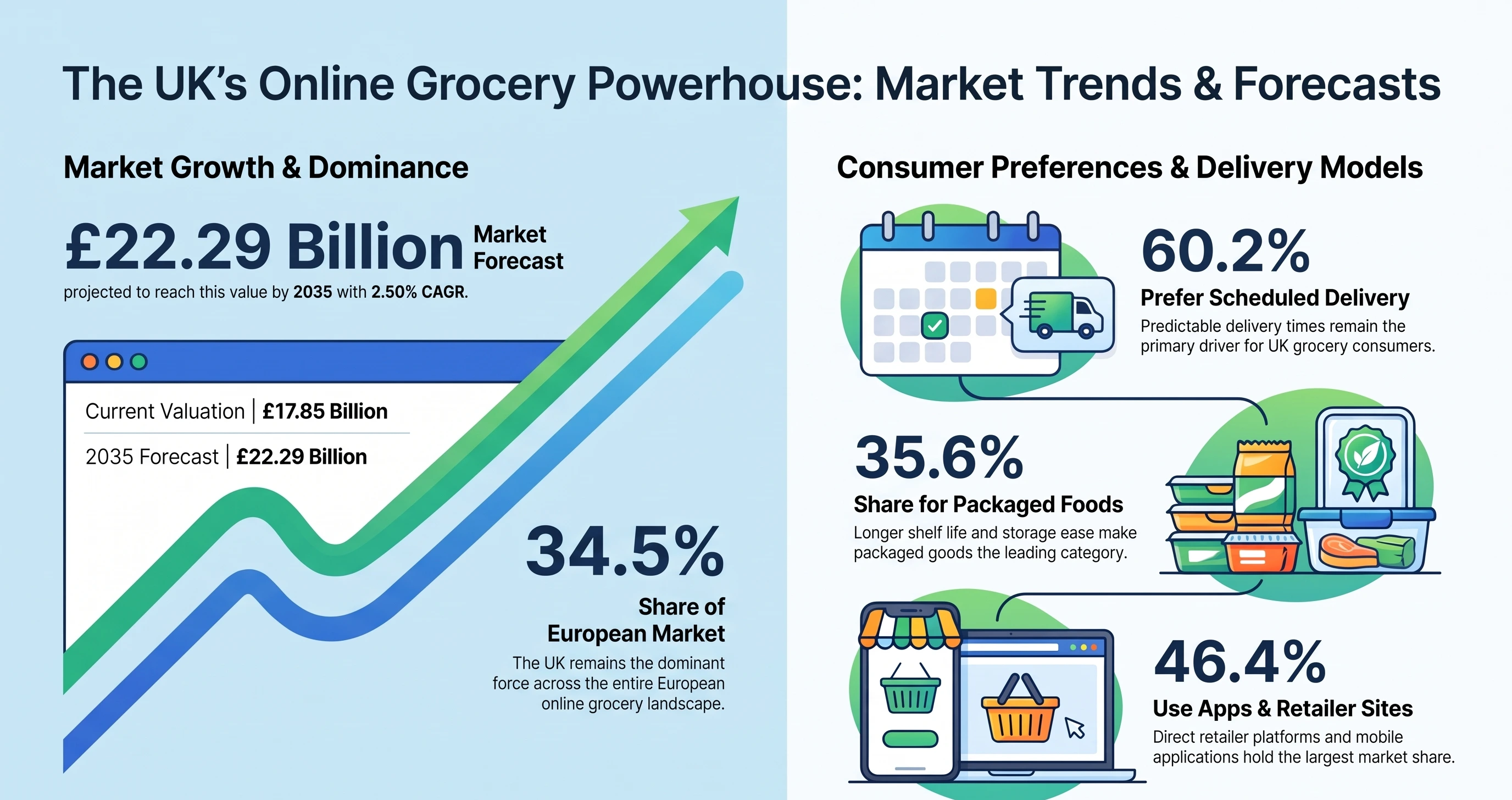
The online grocery market in the UK was valued at £17.85 billion, which is forecasted to reach £22.29 billion by 2035, growing at a CAGR of 2.50%.
The UK remains dominant in the entire European online grocery market, with a whopping 34.5% share.
Based on product category, the packaged food segment accounts for around 35.6% of the entire share in the market, due to longer shelf life and ease of storage.
The scheduled delivery segment dominates the delivery models with a 60.2% share, driven by consumers' preference for predictable delivery times.
Applications and retailer-owned websites hold the largest share in the online grocery market with a 46.4% share.
Understanding the Business Model of Getir
Getir operates through a number of dark stores and small warehouses in different locations of the city. They are only meant to fulfill online deliveries and are not open to the public. Instead of listing on third-party apps, Getir own and manages its inventory by itself. This way, they have full control over stock, product availability, pricing and delivery.
Still wondering how Getir makes money? Here are some of its revenue streams used by most Grocery delivery apps, including Getir:
Product Sales
The main source of revenue for Getir comes from selling groceries and everyday essentials to customers. As Getir own and manages the inventory, they earn full retail margin on these products.
Getir can price strategically on exclusive and private-label products, and margins are often higher on these items. This can also help the app to differentiate from other competitors.
Delivery Fees
Getir also earns money from delivery fees, which it levies on consumers for every order. The typical shipping price in the UK is £1.99.
Moreover, Getir charges a delivery fee for orders below £10 in value. This helps the company to make a profit even on the smaller purchases. At the same time, the app may also levy payment processing fees for credit card payments.
Getir Subscription Model
Getir also offer subscription plans for free or discounted deliveries for a monthly fee. These plans generate steady revenue for the company and increase customer lifetime value.
With subscription models, consumers tend to order more frequently. This leads to stabilized demand and improved order density around dark stores. However, subscriptions are only opted for by customers With frequent ordering. Therefore, it is just a small contribution to the entire revenue ecosystem.
Advertising and Brand Partnerships
Advertising is undoubtedly the most common and highest revenue-generating stream. Brands pay commissions to place their sponsored ads inside the app and sometimes visibility on packaging.
As Getir has both physical and digital shelves, it offers brands end-to-end influence over consumers’ purchasing decisions.
Must-Have Features for a Grocery Delivery App
A grocery delivery app without essential features is nothing more than a digital storefront. To compete in a crowded market, it needs features that create a smooth experience for both customers and delivery partners.
Here’s the list of the core features a grocery delivery app must be integrated with:
Customer App
This is the storefront where your consumers interact, place orders, and raise issues. The main features of the consumer panel include:
Registration/Onboarding for Quick Account Setup
Social login via Google, Apple and Facebook.
Store and product discovery based on location.
Search bar with filters like brand, category, or dietary preferences.
Real-time cart update with dynamic pricing.
Promo code application.
Multiple payment options like digital wallets, debit/credit cards, cash on delivery.
Live order tracking.
Re-order recommendations, order history and loyalty points.
Vendor / Shopper App
This panel of the app is used by store Staff or in-store pickers to receive, pack and deliver the order.
Order notification with product-wise details.
Barcode scanning for each item picked.
OTP-based delivery to the driver.
Real-time inventory update.
Delivery Partner App
This logistics layer is exclusively for delivery partners to manage and deliver the order.
New order notification with accept or reject options.
Optimized routes via Google Maps API.
Step-wise delivery status.
Proof of delivery through OTP.
Earnings dashboard and payout tracker.
Admin Dashboard
It is the centralized dashboard that lets you manage everything from a single web panel.
Order Management: Status of pending, active and delivered orders.
Marketing Tools: Campaign management, loyalty programs and banners.
Store & Vendor Control: Onboarding of stores, performance tracker, and approval management.
CMS & Notifications: Push notifications, email templates and SMS campaigns
Order Dispatch: Live map view, auto-assign routes for drivers.
Accounting & Payouts: Vendor payouts, commission tracking and delivery fee management.
Analytics & Reporting: Product performance, store revenue tracking and customer retention data.
Step-by-step Process to Develop an App Like Getir
Here’s a typical process of developing a grocery delivery app to help you understand how it plan, execute and launch:
1. Define the Business Model
Start by understanding The goals and future perspectives of the business. This stage gives a clear idea about whether the business would sell its own products or partner with a local grocery store, or a combination of both. At the same time, it is also important to decide on the delivery areas and product categories, pricing model, delivery charges and commission structure.
2. Identify the Required Features
Next, prepare the list of features your competitors are taking advantage of and also include those they may have left out. A Getir-like app has three main panels: Customer, delivery partner and admin panel. The detailed list of features for the different panels is listed above for your reference.
3. Design the UI/UX
After you have finalized the features and functionalities of your app, the next stage belongs to designers. The design team will create design layouts, wireframes and prototypes for app screens. The goal here should be to make the shopping experience simple and seamless. People should be able to search for products, add them to the cart and finally able to place orders. The design should work on different screens and devices.
4. Choose the Technology Stack
Once the app design is finalized, it is time to choose the technology to power up the application. The development team may recommend the technology stack required to build the app. This may include technologies for the mobile app, backend, database, APIs, payment gateway, maps, and push notifications. The technology decisions should be based on the expected number of users, required performance, budget, and future expansion plans.
5. Develop the App
After the technological decisions are made, the app will go into production, with developers starting to code and build the backend and frontend. They connect all major functions so that information is transmitted accurately between customers, stores, delivery partners, and administrators.
For example, when a customer places an order, the system processes the payment, updates the status, notifies the delivery partner and allows customers to track the order.
6. Test Every Feature
Testing is the most crucial step of the entire process. The QA team thoroughly checks buttons, logins, product search, cart functions, payments, order placements, location tracking, notifications and delivery updates. They even test the app under high user loads and different network conditions.
7. Launch and Improve
After testing, the app can be published on the required platforms. However, after development, there should be regular monitoring of user feedback, app performance, order data, and technical issues. Based on the feedback, new features and updates can be added from time to time.
How Much Does Grocery Delivery App Development Cost in the UK?
The cost of developing a grocery delivery app like Getir may be around £20,000–£80,000, based on industry averages and estimations. However, the actual cost depends on the features, app complexity, design, and development approach.
Here’s a cost breakdown of grocery delivery app development based on complexities:
Basic grocery delivery app: £20,000–£40,000
Medium-complexity app with advanced features: £40,000–£80,000
Advanced app with AI-based recommendations, store management, and advanced analytics: £80,000 or more.
Apart from this, UI/UX design, backend development, third-party API integrations, testing, security and post-launch maintenance can further add to the overall cost. For an accurate estimate, businesses first need to define their required features list, target users, delivery model and expected app scale.
Conclusion
Developing an online grocery delivery app like Getir can be a promising opportunity for entrepreneurs in the UK grocery market. However, success can’t be achieved only by adding More and more features or offering faster delivery. The app needs to be well-planned, have a better business model in place, a seamless user experience and reliable technology to support.
Each stage in the entire software development process plays an important role in building a platform that users can trust and use daily. If you are planning to develop a grocery delivery app in the UK, Mtoag Technologies can help you build the customer, delivery partner, and admin sides of the platform while keeping your specific business requirements in focus.
FAQs
Why is Getir Shutting Down?
Getir faced financial pressure, high operating costs, intense competition, and challenges in achieving sustainable profitability. The company eventually scaled back operations in several markets to focus on its core business.
How can I Build a Grocery Delivery App?
Start by defining Your delivery model and target market. Then plan features, design the app, choose suitable technologies, develop customer and delivery panels, test them, and launch.
How do I Start My Own Delivery App?
Choose a specific market and delivery service, research competitors, decide how you will earn revenue, identify required features, set a budget, and work with a development team to build the app.