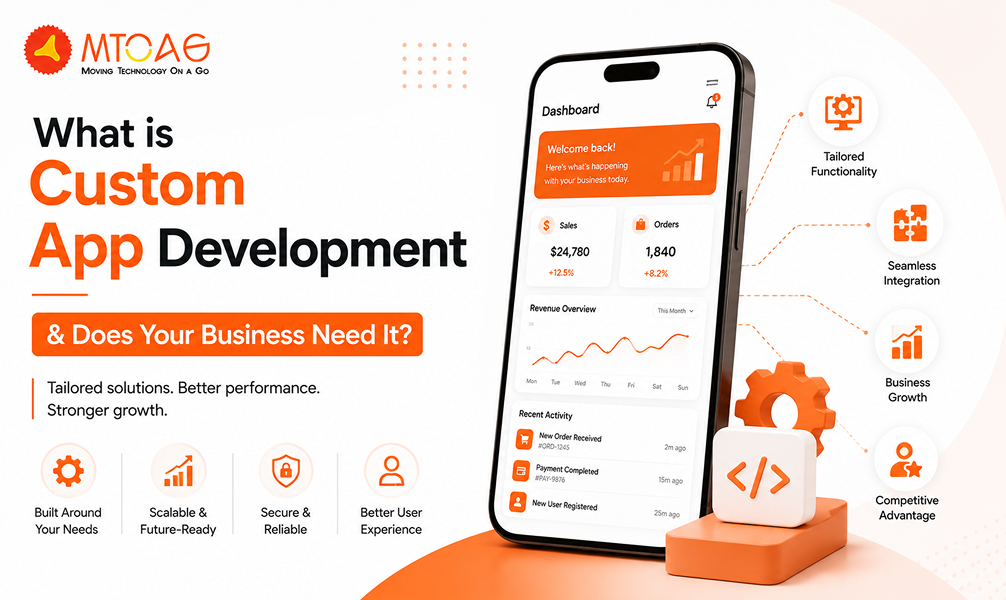
What is Custom App Development & Does Your Business Need It?
Every organization has a different working plan, strategy and principles of operations, and so does its need for digitalization. Often, due to time and budget constraints, businesses compromise on what’s available and invest in off-the-shelf app solutions, only to regret it later. The features look generic, the functionalities are basic, and the software struggles to fit how the business actually operates. However, the modern software industry has a solution for everything, and custom app development seems to be the one fitting well in this scene.
Although off-the-shelf software is convenient and requires significantly low initial investment, many enterprises still need custom-built applications tailored according to their teams, customers and specific use cases. And in terms of RoI, custom-built solutions generally offer stronger long-term value because they are designed around business goals rather than generic user requirements.
But does every business need custom app development? Particularly, does your business need it? Let’s find out through this detailed guide that will explain the basics of custom application development, alongside the detailed comparison with off-the-shelf solutions. As a team of industry insiders, we will also explain the benefits, typical process and the average cost of developing a custom app.
What is Custom App Development?
Custom application development is a strategic process of designing, developing, deploying, and maintaining a software system for the unique requirements of a business, organization, or enterprise.
Unlike off-the-shelf (ready-made) software solutions that are generic and created for a broader market, custom apps are generally designed around your business’s specific workflows, customer experiences, operational goals, integrations and unique challenges. The software is designed to match how businesses operate instead of adjusting to fit the off-the-shelf solutions.
The custom application development lifecycle includes
Deciding on building either a web application, a mobile app or a desktop software.
Developing internal tools and management platforms for business.
Building front-end (customer-facing) portals and service apps
Thrid-party API integration for seamless communication between systems and applications
Automating manual business processes, especially through AI-powered apps
Integrating the missing features that your legacy software lacks
For instance, a ready-made application system is like purchasing a suit directly from the store. It's delivered immediately, costs less and fits most people. But the problem is it's generic, you may see many people carry the same; there might be a fitting issue, sometimes there are extra buttons or designs that you didn’t want but can’t change, so you have to adjust.
But custom application development is like getting a suit stitched according to your exact measurements and preferences. Although it is quite costly and requires extra time, everything is designed around your specific needs, preferences and future needs. The fit is better, the adjustment is easier, you can use it for a long time, and, most importantly, you get what you always wanted.
Key Takeaways
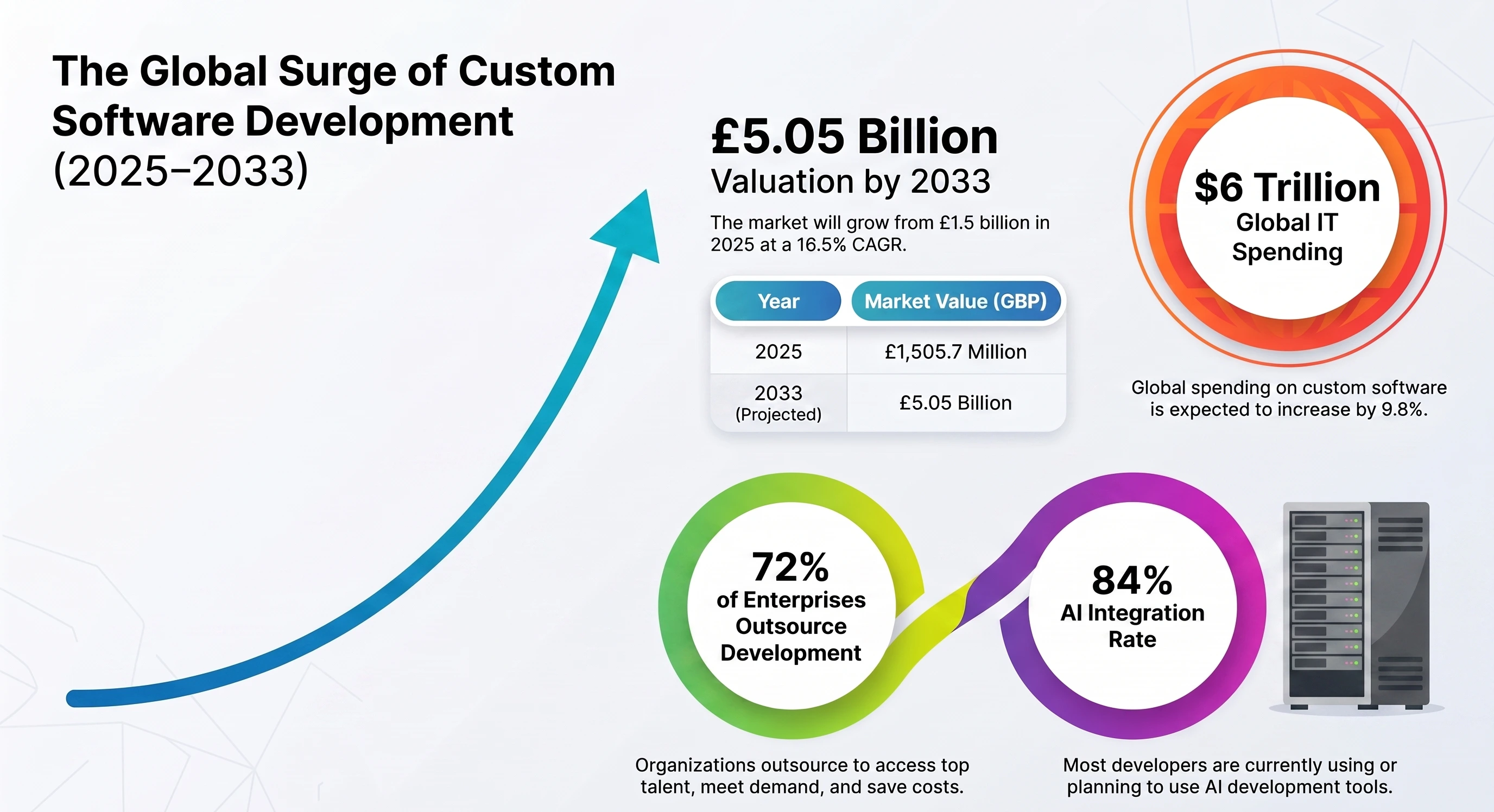
The custom software development market is worth £1,505.7 million in 2025 and is expected to grow at a CAGR of 16.5% to reach £5.05 billion by 2033. (Source: Grand View Research)
The IT spending on custom software is expected to reach $6 trillion globally, increasing by 9.8%. (Source: itransition)
72% of enterprises outsource software development or better talent, meet increasing customer demand and save costs. (Source: itransition)
84% of developers are either using or plan to use AI tools in their software dveelopmemt process. (Source: itransition)
Custom App Development vs Off-the-Shelf App Solutions
To help you understand the best choice between custom app vs off-the-shelf software, here’s a side-by-side comparison based on key parameters and aspects:
Note: The cost ranges are just an estimation to keep the comparison realistic and may vary by vendor, region, requirements and integrations.
Signs Your Business Needs a Custom App
Many businesses don’t realize the need for custom app development until operational slowdown starts to impact their day-to-day work and growth potential. The strongest signs of a software upgrade are not when your team demands advanced features, but when you start to feel like your business decisions, workflows, and even customer experience have started to get impacted because of your existing software limitations.
Here are some other signs to watch out:
1. Your Team Has Created Too Many Workarounds
Your team members are still using emails, spreadsheets, messaging tools and different software programs to complete just one process. That’s not the productivity issue, but the sign for the need for advance system. These workarounds often go unnoticed until they start to impact daily operations and start slowing the business.
2. New Business Ideas are Becoming Difficult to Execute
Coming up with a growth idea isn’t as challenging as executing it. If your team comes up with a new service idea, pricing model, workflow or customer journey, but it requires multiple tools and in the end abandoning the idea altogether, there are high chances that your existing system is restricting business decisions instead of supporting them.
3. Technology Spending Keeps Increasing
If you're draining out your IT budget but still not getting what you expect, it is a strong sign your need a software upgrade. Using off-the-shelf solutions, businesses typically spend on multiple subscriptions, extra users, premium integrations, and third-party extensions. But despite these expenses, the operational efficiency remains unchanged, which may indicate the need for a more unified system.
4. Teams Operate Separately
Every department of the business, including sales, marketing, operations, customer support, finance and management, should never depend on a disconnected system or manual updates. When teams are unable to access shared information easily, it is common to face delays, duplicate work and inconsistencies.
5. Business Growth is Creating More Complexity
With better growth, there comes improved efficiency through advanced systems. But if every new customer, employee, or service increases operational pressure rather than decreasing it, that’s the sign that your business has outgrown standard software capabilities.
Benefits of a Custom Application Development
Custom application development empowers businesses with the ability to build technology around their exact operational needs. A custom app has many benefits for businesses that mainly include:
Process Alignment
Custom applications are built to automate and ease existing business operations while reducing unnecessary & repetitive work and dependence on multiple tools for one process. With better process alignment, teams can spend less time on system management and more time on productivity.
Scalability
Off-the-shelf software solutions can’t keep up with your business’s growing requirements and growth. But custom applications can scale with new features, user roles, integrations and capabilities without forcing a complete system replacement.
Improves Efficiency and Visibility
Having everything in one centralized place helps reduce delays and supports better decision-making across multiple departments, which in turn improves efficiency and visibility. With a custom app, employees can work with a specialized system that is specially built around their responsibilities.
Better Customer Experiences
From the user perspective, custom apps deliver relatively better experiences through smooth service delivery, personalized interactions and interfaces designed around actual user expectations. As a result, businesses can expect better engagement and improved customer retention over time.
Security and Control
With off-the-shelf software solutions, the security and data control remain with the vendor or service provider, which can create limitations on customization and compliance requirements. Meanwhile, custom software offers complete ownership over permissions, security control, features, integration and data management rather than depending on a third-party software vendor.
What is the Typical Process of Custom App Development?
The development of a custom application is a structured process and involves a few crucial stages that demand the efforts of the development team and the business itself. Although every mobile app development company has their own ways of doing things and a unique process, here we will discuss the typical steps involved in the SDLC, so you at least know what to expect.
1. Choosing the Right Application Type
The first and foremost step is to brainstorm on the type of application that fits within your business objectives and project scope. Software applications include the following categories:
Mobile App: Software programs developed specifically for mobile phones and tablets for a more device-focused experience.
Web App: They can be accessed through web browsers and are designed for cross-device accessibility.
Progressive Web App (PWA): These can be understood as the advanced version of web applications with more app-like functionality and improved performance.
Hybrid App: These software programs use a shared codebase to run on multiple operating systems (OS) while reducing the development cost and efforts.
Once you know which platform to focus on, the development team can accordingly work on design, technology stack, coding and future scalability.
2. Requirement Discovery and Planning
After finalizing the application type, the focus shifts towards understanding the core business requirements, goals, targeted audience, operational challenges and what the client actually expects. During the discovery sessions, sit with the development partner to figure out features, workflows, integrations, timelines, and technical priorities during this stage.
3. UI/UX Design and User Journey Mapping
Before the development actually starts, businesses may need to know what the application will look like. Therefore, this stage involves creating wireframes, screen layouts, navigation paths, and interaction flows. Once they are approved, the process advances to the development stage.
4. Development and Feature Implementation
Now that everything else is finalized, the main process of coding starts at this stage. Developers build the front-end experiences where the users will interact with and the backend systems that will manage business logics, data, APIs and integrations. Features and functionalities are also implemented in this stage, so progress can be reviewed continuously.
5. Testing and Quality Assurance
Even after the development, the application can’t be deployed or launched right away. It needs to go through a thorough testing nd quality assurance process. The testing stage makes sure the application works well across devices, browsers and real-life usage conditions. It includes testing the functionalities, security, speed, responsiveness and usability.
6. Deployment, Support, and Continuous Improvement
After everything goes smoothly, it's time to deploy the application and monitor it in real-world conditions. However, it is important to note that the application’s performance on launch day is not the final measure of success. To continue delivering value over time, the application requires ongoing updates, performance optimization, feature enhancements, and regular maintenance so it remains aligned with changing business requirements, user expectations, and operational needs.
How Much Does it Cost to Build a Custom App in the UK?
Estimating the cost of a custom application is quite challenging without the exact requirements, complexity level, feature lists and integrations. However, we can figure out the industry averages to give readers a cost idea.
An MVP (Minimum Viable Product) application with core functionalities only and limited workflows generally costs around £15,000–£30,000. However, the cost gradually increases to £35,000–£80,000 for mid-level complexity applications with features like a custom dashboard, user roles, APIs, and automation.
At the same time, an enterprise-grade application with real-time processing, AI capabilities, complex workflows, advanced integrations and multi-platform support can cost around £100,000, or even more.
Conclusion
So that was it! A custom app is not just a software solution, but something that fits the way a business operates today while giving it the flexibility to grow. Instead of pushing companies to adjust, these software systems help create space for long-term progress.
However, it is important to note that custom development here doesn’t mean adding more and more features to make it feature-heavy, but building the right solution that works with the business.
For businesses looking for custom applications, Mtoag Technologies brings together 17+ years of technical expertise, business understanding, and a development approach focused on creating solutions that remain useful well beyond launch.
FAQs
How Long Does It Take to Develop a Custom App?
Custom app development timelines depend greatly on features, complexity, integrations, and testing requirements. A basic application may take around 2–4 months, while larger business platforms often require 6 months or more for proper planning, development, and launch.
How to Build Your Own Custom App?
Building a custom app usually starts with defining the problem, identifying users, listing required features, selecting the right app type, designing the experience, developing the product, testing thoroughly, and improving after launch based on usage.
Which is the Best Custom Application Development Company in the UK?
Although there is no universal answer because the best development partner depends on business goals and project complexity, companies such as Mtoag Technologies are often considered by businesses Looking for custom app development due to their focus on building solutions around specific operational requirements rather than offering one-size-fits-all products.
Are Custom Applications Better Than Ready-made App Solutions?
Custom applications are better when businesses need flexibility, specific workflows, scalability, or deeper integrations. Ready-made solutions work well for standard needs, but custom development provides greater control as requirements become more complex.