What is Software Outsourcing & How It Benefits UK Businesses?
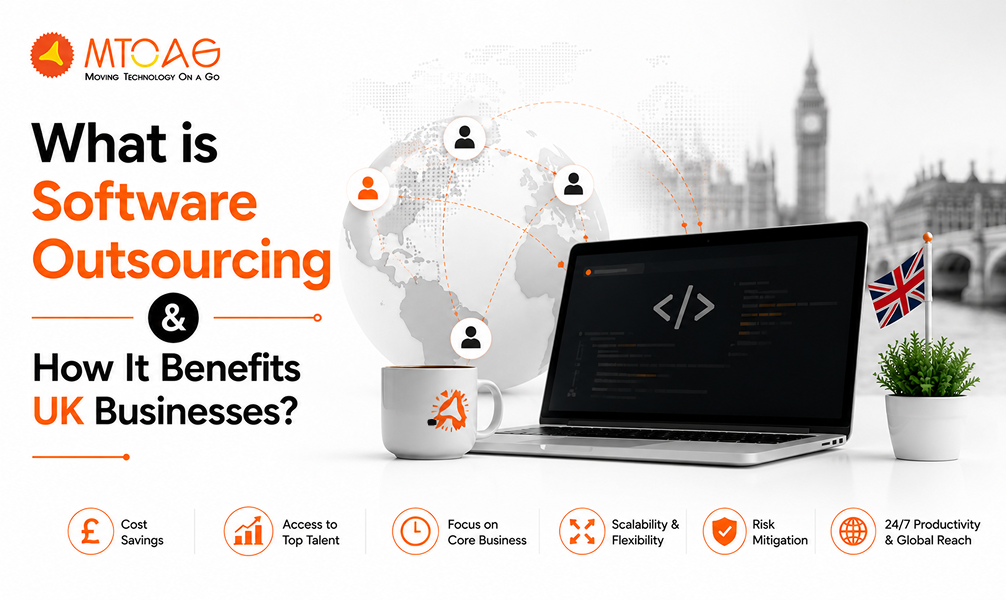
With ever-increasing globalization and demand for skilled yet cost-effective development teams, the local UK businesses and enterprises are increasingly turning to software outsourcing. In fact, around 63% of UK-based organizations leverage software outsourcing to expand or maintain their development capabilities.
For businesses having no idea about software development outsourcing, let us tell you that it is one of the most common yet effective business strategies that allows companies to hire third-party vendors, external teams or agencies to handle development, maintenance, testing, or other extended IT services.
Software outsourcing is a broad strategic practice, and approaching it without proper knowledge can lead to uncertainty, misaligned expectations, and costly decisions. Therefore, we have created this comprehensive software outsourcing guide, specifically for UK businesses, so they can better understand the next steps and make decisions accordingly to get the best out of their partnership.
What is Software Development Outsourcing?
Software development outsourcing, or software outsourcing, is a business approach where companies can hire third-party vendors or software development companies to do specific tasks on a contract basis. These tasks may include -
End-to-end software development
Product discovery
Quality Assurance & Testing
UI/UX design
Application maintenance and support services
Depending on the outsourcing type you choose, your outsourcing partner can either take full responsibility for development or assist without having direct control over project management.
The most appealing reason why UK businesses are leaning towards software development outsourcing remains the cost savings. The cost of living in the United Kingdom, especially in cities like London, Oxford and Brighton, is high compared to its European counterparts.
Outsourcing to the Eastern European region or the Asian region can save up to 60% on staffing expenses, as hourly rates of developers in these regions are much lower than in the UK. Apart from cost efficiency, outsourcing opens up access to a global talent pool, and low labour costs here don’t mean fewer skills.
UK’s Software Outsourcing Market Insights
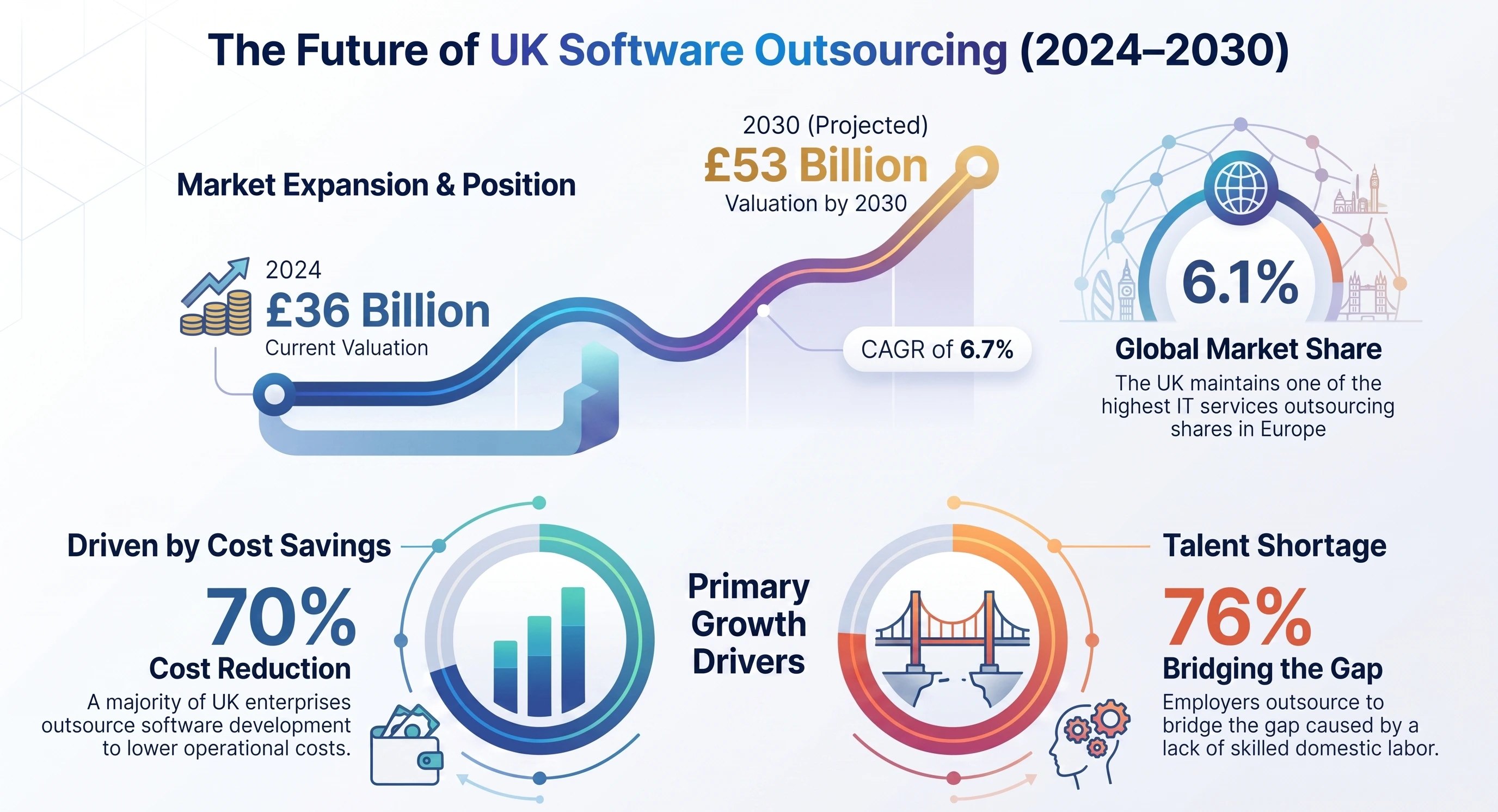
The UK’s software outsourcing market was valued at £36 billion in 2024 and is expected to reach £53 billion by the Year 2030, growing at a CAGR of 6.7%. (Source: Luminary Brands)
The UK accounts for a 6.1% share in the global IT services outsourcing, with one of the highest shares in Europe. (Source: Luminary Brands)
A recent survey reveals that 70% of UK enterprises outsource software development to lower their operational costs. (Source: Luminary Brands)
76% of UK employers struggle to fill positions because of a lack of skilled labour and a talent shortage. (Source: Luminary Brands)
What are the Different Types of Software Outsourcing?
There are six main types of software outsourcing models, and having a good understanding of each helps businesses to choose the right one according to their needs, requirements and project complexity.
So, here’s a simple breakdown:
1. Onshore Outsourcing
Onshore software outsourcing refers to hiring a software development company in the same country as your business operates. For example, you are running a company in Manchester and outsourcing your development project to an agency based in London. The benefits of onshore outsourcing are better communication, as you and your partner are in the same time zone, and language is never a barrier. However, this software outsourcing option is quite expensive compared to others.
2. Nearshore Outsourcing
In nearshore outsourcing, companies hire the development team in a nearby country, usually with a similar or a close time zone. For example, a London-based company hiring a software development agency in Ireland or Poland. As said, the time zone is similar or relatively closer; this business approach offers a good mix of cost savings and better communication.
3. Offshore Outsourcing
Offshore software outsourcing remains the most popular model for saving costs and hiring the best talent around the world. For example, you are free to hire from any region, even from countries with cheaper hourly rates, such as India, Ukraine and the Philippines. These countries are known to offer high-quality development services while being extremely cost-effective.
4. Project-Based Outsourcing
Project-based software outsourcing refers to hiring an agency to handle a specific project. Once the agency completes the project, the negotiation ends; however, you can extend it for maintenance and support services. This approach is best for businesses with a clear and one-time need.
5. Dedicated Team Model
Under this outsourcing approach, you can hire a team that works exclusively on your project as an extension of your in-house team. This outsourcing model is ideal for businesses with long-term project requirements or products that need consistent updates and support.
6. Staff Augmentation
Staff augmentation is probably the best outsourcing approach as it allows organizations to add remote developers to their team in addition to their existing in-house team. Although they are employed by your Outsourcing partner, they will work under your management. It is ideal if your in-house team lacks a specific skill or you need extra help for a specific period.
Benefits of Outsourcing Software Development
Software outsourcing offers plenty of benefits to businesses seeking cost-effectiveness without compromising the quality of work or skills.
Here are some benefits of software outsourcing:
Cost Savings
Making the most out of the development budget remains the first priority for businesses. They do everything to save costs, at least wherever they can. Outsourcing the software development to countries with lower hourly rates of developers saves a significant cost on the entire project. At the same time, you are not bound to pay for employee benefits, overhead, office rent, furniture, and other resources, which you need to take care of if you recruit in-house development teams.
Outsourcing to regions with lower labour costs, especially India, is a long-standing and common outsourcing practice for UK businesses. In comparison to hiring in-house teams, outsourcing offers much higher-quality services at a lower cost.
As service providers offer complete software development services, outsourcing eliminates the need to invest in emerging technologies, high-cost infrastructure and development tools.
Access to Skilled Professionals
The second-best thing about software outsourcing is having access to skilled professionals around the world. Businesses can look for specialists regardless of their location, which gives them access to a global talent pool of software developers.
Outsourcing makes it easier for businesses to find a suitable development team with specialized knowledge in advanced technologies and development processes. The model is specifically beneficial for companies that want to create sophisticated software solutions, as it gives them access to the specialized knowledge they need as per their project requirement.
Furthermore, outsourcing helps businesses benefit from the experience of skilled software development agencies that have years of experience working on various projects.
Improved Efficiency
Outsourcing adds enhanced productivity to the entire project. But how? As businesses can outsource their development to specialized service providers, they no longer need to focus on this aspect anymore. They can concentrate on their core business activities and increase the efficiency of their enterprise.
The software development tools, strategies and the infrastructure used by software Outsourcing companies are often well-established and time-tested, which enables them to deliver more timely and more advanced development.
As the outsourcing partner is in charge of everything, businesses don’t need to spend time and money on training their employees. Businesses can focus on their core competencies and leave development to the experts, saving both money and time in the process.
Flexibility
Flexibility is yet another benefit you get when you outsource software development. As with your business conditions, you can adjust your development activities without any commitment. Businesses with wings demands may find the outsourcing ideal as it allows them to modify their software development requirements to match those shifting needs.
With shifting demands, businesses can increase or decrease resources at any time as per their needs when they outsource. Businesses can adapt to changes in demand, and it also guarantees that businesses have the necessary resources to meet those demands.
Enterprises can choose the best software outsourcing services for their needs, depending on timeline, pricing and other technical requirements. This helps them strike a balance between quality, price and time to market.
As service providers are experts in leveraging new tools and technologies, outsourcing helps businesses access the latest software. This is particularly ideal for companies that need to stay ahead of their competitors.
Faster Time-to-Market
Faster time to market is one of the key benefits of software outsourcing for UK businesses. They can access a global talent pool for software development, which helps them to complete projects more efficiently and faster than in-house teams.
The infrastructure, tools, experience and expertise that service providers possess help them accomplish projects more efficiently and faster than internal teams. If you opt for in-house software development, you need to spend on training your internal team to finish the project. However, that’s not the case with outsource development companies as they already have a skilled and experienced team that adapts according to your project.
How to Outsource Software Development for Maximum Benefits?
Before outsourcing your software development to any agency or team, it is important to understand the process so you can better know the next steps.
Step 1: Define Your Project Clearly
Before you even think of outsourcing, it is important to do a self-assessment of your requirements and needs. Ask yourself a few questions:
What problem will your software solve?
Who will be your target users?
What are the main features you need?
What is your project budget?
What is your project deadline?
Once you have answers to these questions, you can better convey your requirements to the outsourcing partner, and it even gives them clarity to deliver the expected results.
Step 2: Choose the Right Outsourcing Model
Based on your assessments, requirement analysis, budget and timeline, choose the outsourcing models that better align with these aspects. You have the option to choose between onshore, offshore, and nearshore software outsourcing models. If you are still unclear, a professional outsourcing company can help you figure this out during the discovery call.
Step 3: Research and Shortlist Companies
Search for the best software outsourcing companies with a proven portfolio of such projects, positive client reviews and relevant industry knowledge. You can research for companies’ reliability through platforms such as GoodFirms, Clutch and LinkedIn. Just not choose the cheapest option, but look for
Technical expertise and tech stack
Security and NDA policies
Communication skills
Portfolio and case studies
Pricing model (fixed price vs. hourly vs. monthly retainer)
Post-launch support
Alternatively, you can choose Mtoag Technologies, which specializes in software outsourcing services and end-to-end development, which includes idea, planning, UI/UX design, development, testing and launch. We have so far delivered 2500+ projects across healthcare, e-commerce, Fintech and education industries.
Step 4: Set Up Communication and Start with a Small Pilot Project
Communication is everything in a software outsourcing partnership. Make sure to agree on communication tools (Slack, Jira, Zoom), sprint cycles, reporting frequency and escalation process.
Once you are done with communication setup, start with a small pilot project. Give them a limited scope project to check their capabilities, delivery quality, timelines and communication before committing to long-term engagement.
Step 5: Monitor Progress and Iterate
Even if you give them a small pilot project, it is important to keep track of. Use agile methodology and work in sprints, review progress regularly and give timely feedback. Review how they work on your feedback and understand their methodology.
How Much Does Software Outsourcing Cost in the UK?
The average cost of software outsourcing projects typically falls under the range of £30 to £150+ per hour. However, it greatly depends on the service provider’s location, experience and technical knowledge. The estimated budget for MVP development in the UK ranges from £15,000 to £100,000+ for enterprise-grade platforms.
Based on location, the average hourly cost of software outsourcing is:
Onshore (UK/Western Europe): £60 – £150 per hour
Nearshore (Eastern Europe): £25 – £70 per hour
Offshore (India/Southeast Asia/LATAM): £15 – £50 per hour
Dedicated Teams: A full-time remote offshore/nearshore developer demands £2,500 – £6,000/month, depending on location.
Conclusion
Software outsourcing is undoubtedly the best possible option for local UK businesses to get the best and expert software development services at half the cost of hiring an in-house team. Through this software development outsourcing guide, we tried to explain what software outsourcing is, how it works, its key benefits, different models, and the average cost.
However, the success of any outsourcing initiative ultimately depends on selecting the right technology partner. A reliable software consulting company can do much more than provide developers. It can help define project requirements, recommend the right technologies, mitigate risks, and ensure that software solutions align with long-term business objectives.
With over 17 years of industry experience, Mtoag Technologies has been helping startups, SMEs, and enterprises with scalable digital solutions. As a complete software consulting and development company, Mtoag offers end-to-end services ranging from technology consulting and product strategy to custom software development, mobile app development, AI solutions, cloud integration, and post-launch support.
FAQs
What Do You Mean by Software Outsourcing?
Software outsourcing is a business practice of hiring an external company or development team to handle software-related tasks such as application development, testing, maintenance, or support instead of managing everything with an in-house team.
Which Country is Best for Outsourcing?
India is widely considered one of the best countries for software outsourcing due to its vast pool of skilled developers, cost-effective services, strong English proficiency, and extensive experience in delivering projects for global businesses across various industries.
What is the Most Commonly Outsourced IT Service?
Custom software development is one of the most commonly outsourced IT services. Businesses frequently outsource web development, mobile app development, software testing, maintenance, and cloud-related projects to access specialized expertise.