Fintech App Development in the UK: Features, Costs & FCA-compliant
Did you know that the UK’s fintech industry is the largest in Europe and globally the second only to the US? The fintech market in the UK is estimated to be around £15.87 billion and is expected to grow at a CAGR of 15.42% to reach £32.69 billion by 2031. For finance businesses and startups, this growth signifies underlying opportunities in the market. However, the compliance-heavy landscape and increasing customer expectations demand that fintech app development be more secure, compliant, and built for long-term trust rather than just speed.
So, how do you build a fintech app that not only meets customers’ requirements but also complies with regulatory standards and earns users’ trust?
Drawing from our extensive experience of over 17+ years in software development and financial services, we created this guide that will explain every phase of fintech app development, along with its cost, features, benefits, and understanding of FCA compliance.
What is a Fintech App and Why It Matters for UK Businesses?
A fintech app is a software program that offers financial services through a digital interface, mainly through a mobile app or a web-based interface. The category of fintech apps is broader and includes mobile banking platforms, digital wallets, peer-to-peer payment systems, investment tools, insurance management products, lending platforms and open banking applications.
The main distinction between a standard business application and a fintech app is the regulatory environment, the security architecture and the consequences of failure. While a bug in a retail app can cause inconvenience, a bug in a fintech app may cause regulatory exposure, financial harm and reputational damage.
Therefore, it's essential to choose a reliable fintech app development partner in the first place that understands the legal frameworks, including FCA authorization, PSD2 compliance, UK GDPR, PCI DSS for any card-handling functionality, and AML/KYC obligations.
In the UK alone, there are 1,600 active fintech companies, and the numbers are increasing. And the pressure of building an advanced app has never been greater. Businesses are turning towards AI integrations to offer what their competitors have missed.
The influence of AI in the fintech industry is not hypothetical but driven by real Impact. For instance, NatWest reported a 90% reduction in new account fraud since 2019 after using AI-driven detection systems. At the same time, Revolut launched its PRAGMA foundation model in 2026, trained on 26 million user records, which achieved a 64.7% improvement in fraud recall and a 130.2% uplift in credit scoring accuracy.
Fraud detection remains the highest valued AI application in the fintech sector. Machine learning models analyze device fingerprints, transaction patterns, location data, and behavioural signals to flag or block transactions if they deviate from a customer's established pattern.
Understanding FCA Compliance for Fintech Apps in the UK
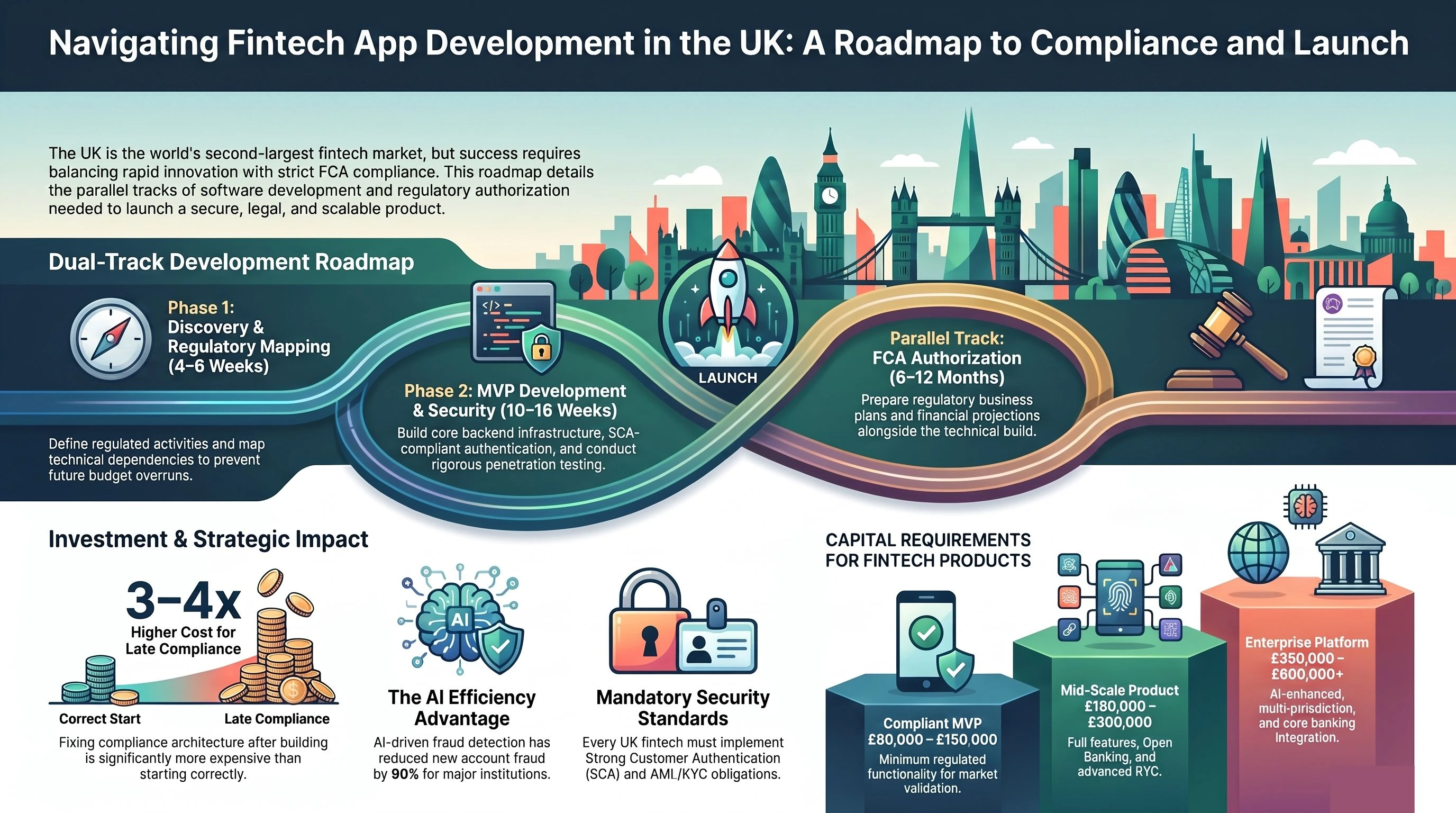
FCA compliance is something where many UK-based fintech companies go wrong and cost the entire development. Making changes to compliance architecture after the product is already built attracts 3-4 times more cost than building it correctly from the start.
The Financial Conduct Authority (FCA) oversees over 51,000 financial institutions in the UK and is a primary regulatory body for every fintech product that requires regulated activities. So, before you start, it is important to ask which regulatory activity your fintech app will perform.
To help you understand better, here are the main author ization Categories relevant to fintech app development:
Electronic Money Institution (EMI) Authorization: It is applied to products or services that enable payment transactions or issue e-money. This category covers digital wallets and prepaid card products. An EMI should hold regulatory capital and comply with the Payment Services Regulations 2017, while safeguarding customers' funds.
Payment Institution (PI) Authorization: This category covers payment processing and initiation services. Products that initiate transfers on behalf of customers generally require PI authorization.
Account Information Service Provider (AISP) Registration: This covers products or services that aggregate customers’ account data from multiple accounts with their consent. It requires FCA registration, robust security standards, and data handling policies under UK GDPR.
Consumer Duty Compliance: This has been in force since July 2023 and requires firms to show that their products deliver good results to customers with evidence.
AML and KYC Obligations: These apply to every service and product involving financial transactions. Under the Money Laundering Regulations 2017, it requires customer due diligence at onboarding and ongoing transaction monitoring. The FCA confirmed in early 2025 that only 14% of cryptoasset business applicants had successfully achieved AML registration.
PCI DSS: This category is for any product that stores, processes or transmits customers' card data. It is mandatory to follow the Payment Card Industry Data Security Standard compliance.
Core Features Every Fintech App Needs
The features of a fintech app generally depend on its regulated activities. That said, some foundational features should be there for every fintech product built explicitly for the UK market.
Secure User Authentication
According to the Payment Services Regulations 2017, the implementation of PSD2 is mandatory and requires Strong Customer Authentication for most payment transactions. This involves multi-factor authentication through a password or PIN, a registered device and biometric data. Make sure your fintech app development team emphasizes building SCA correctly from the architecture stage.
KYC and Identity Verification
These two together represent the most challenging and complex areas in fintech app development in the UK. The Money Laundering Regulations 2017 require regulated firms to verify and assess risk, customer identity, and conduct ongoing monitoring.
Real-time Transaction Processing
This feature is something we can call a baseline expectation at least. The adoption of open Banking in the UK is rising, with a current active user base of 16 million. Fintech apps that can’t display or process transactions in real time are at a structural disadvantage.
Audit Trails and Compliance Logging
They are not front-end features but something that regulators will require. Every financial event counts, whether it's a login, a transaction, failed authentication attempts or reversals, requires to be timestamped, logged and retained for regulatory inspection.
Open Banking API Connectivity
API connectivity has moved to a standard feature expectation in modern fintech architecture. The FAC’s open banking framework allows regulated third-party providers to access payment initiation and account data through standardized APIs.
Push Notifications and Smart Alerts
The notification features keep the customers engaged and alerted. These notifications may include payment confirmations, spending alerts, personalized financial advice, and fraud warnings. This feature significantly improved retention metrics.
Step-by-Step Process of Fintech App Development
Prior understanding of the fintech app development process can help businesses set realistic expectations on budget, timelines and decisions.
Discovery and Regulatory Mapping (4–6 weeks):
Everything starts with a discovery phase to define regulated activities, map the targeted audience, compliance architecture, decide on technical specifications and identify third-party dependencies (KYC providers, payment processors and banking APIs). This phase generally costs around £10,000–£20,000 and prevents budget overruns from the start.
UI/UX Design (3–5 weeks)
Financial applications are often appreciated for their high trustworthiness. Users make decisions about their money based on how confident the product feels to them. Good UX is all about demonstrating product safety features to customers. This design phase includes wireframes, prototypes, and user-tested flows before core development starts.
Core Development (10–16 weeks for MVP, 6–12 months for full product)
The development stage starts with building the backend infrastructure of the app, which includes APIs, security architecture, databases and compliance logging. It also includes the front-end design of the application. For developing apps in such a regulated industry, the backend is generally more complex and expensive as operations require concurrency handling, transaction accuracy, regulatory reporting and audit trails.
Security and Compliance Testing (3–4 weeks)
After development, the application should go through rigorous testing nd quality analysis phases to ensure it is free from bugs and flaws. The financial application should be free from bugs, as they are comparatively more vulnerable to cybersecurity attacks and hacking. This stage includes penetration testing, compliance audits and vulnerability assessments. Many banking partners may require evidence of complete security testing before granting API access.
FCA Authorization (parallel track, 6–12 months)
The FCA application runs parallel with the development stage. However, preparing for the application is a different undertaking, which may include a regulatory business plan, financial projections, compliance framework and management team disclosures. Many fintech businesses underestimate the need for FCA author ization And rush the launch even before the regulatory pathway is clear. But it may raise regulatory concerns later and create operational challenges once the platform goes live.
Launch and Ongoing Compliance
A fintech application will require frequent updates to remain relevant with the evolving regulatory requirements, growing FCA’s supervisory expectations and changes in fraud patterns. You should set up a budget for regular penetration testing, ongoing compliance monitoring and regulatory reporting from the onset of the development.
What Does Fintech App Development Cost in the UK?
The development cost remains the first question every founder and product leader has in their mind. The fintech app development cost in the UK ranges between £80,000 for a compliant MVP to £400,000 or more for a full-featured regulated application.
MVP Fintech Apps (£80,000–£150,000): An FCA-compliant MVP has the minimum regulated functionality that is needed to validate the business model and launch to early users.
Mid-scale Fintech Products (£180,000–£300,000): A full banking or financial application with a full set of features, open banking integrations, multi-currency support and advanced KYC capabilities. It requires at least 5-6 developers to work on this level of project.
Enterprise Fintech Platforms (£350,000–£600,000+): This includes more advanced AI-enhanced platforms integrated with core banking systems and serving regulated institutions and multi-jurisdiction products.
Apart from this development cost, there is a KYC verification fee, which is generally £2–£5 per check. For a fintech app with thousands of active users monthly, this may turn out to be a high operational cost.
Conclusion
Fintech app development in the UK rewards careful preparation and penalizes those who take shortcuts. The UK’s financial regulatory environment is complex, but your innovation makes it possible for businesses to scale. The fintech companies that develop with regulations in mind, engage compliance expertise early and design their AI integration with explainability are sure to have an advantage in the market.
For businesses considering fintech app development, make sure you tick the three crucial checklists that include defining the regulated activity before coding, building the compliance architecture, and choosing a development partner who has delivered regulated financial products in the UK specifically.
Meanwhile, Mtoag Technologies helps UK finance businesses approach development with that balance of compliance awareness, technology, scalability and practical execution. With a rich portfolio of fintech app development, AI-powered solutions and secure digital products, we support startups and enterprises to build financial apps ready for both users and the country’s regulatory expectations.
Frequently Asked Questions (FAQs)
Does a Fintech App Always Need FCA Author ization In the UK?
Not always, but yes, most financial products or services that handle customer money or payment data require some form of FCA registration or authorization. The specific requirement depends on the regulated activity. Payment initiation and account information services require different author ization Pathways. Any team building a UK fintech product should obtain formal legal advice on regulatory obligations before beginning development.
How Long Does It Take to Build and Launch a Fintech App in the UK?
A compliant MVP takes 10–16 weeks to develop. The FCA author ization Process runs in parallel and typically takes 6–12 months from submission to approval. Businesses that begin both processes simultaneously and those that engage compliance expertise from the outset are best placed to launch within a 12–18 month window from initial concept.
What is the Minimum Cost to Build a Fintech App in the UK?
A compliant MVP with the minimum regulated functionality needed to validate the business model typically costs £80,000–£150,000 with a development partner. This includes the core architecture, KYC integration, security testing, and FCA-aligned compliance logging.
How Does AI Improve a Fintech App's Performance?
AI delivers measurable improvements across fraud detection, credit risk assessment, customer personalization, and compliance monitoring. The FCA expects firms to understand and account for the decisions their AI systems make.