AI Copilot for Enterprises: Benefits, Use Cases & Development
Modern enterprises in the 21st century are under constant pressure to do as much as possible with limited resources. But the biggest challenge remains the race against time. For instance, spending too much time on tasks that should take minutes. The need for a faster, more intelligent way of working has never been as high as it is today, possibly the reason why AI Copilot is seeing a swift adoption across different sectors.
You can see this shift in numbers. The global AI Copilot market was valued at $16.94 in 2025, and now it jumped to $21.59 billion in 2026, that’s a 27.4% increase in just a year. Even more striking is the fact that it is further projected to reach nearly $126 billion by 2035, according to Prophecy Market Insights.
At a time when AI is already dominating a good half of all industrial & business processes, still delaying AI adoption is something like pushing yourself back in the competition. Let us today understand how AI Copilots are dominating the business space, what benefits they are bringing and where they are creating real impact.
What is an AI Copilot?
An Artificial Intelligence (AI) Copilot is a conversational assistant that uses Large Language Models (LLMs), Machine Learning, enterprise data and system integrations to help users in automating tasks, retrieving crucial information and streamlining workflows.
Here’s how AI Copilot works: A user types or speaks what they need. The Copilot understands the context, finds the relevant information and responds with the results.
In simple terms, it helps companies reduce human errors and complete tasks faster by reducing Repetitive work. An enterprise-grade AI Copilot is powered by LLMs, the same technology that fuels ChatGPT. It is fine-tuned with the enterprise’s internal data, integrates it with business tools and operates within its security and governance policies, which means the responses are specific to the company, its data and employee roles.
For example, if you need to prepare your annual marketing report. You simply prompt the Copilot to “Prepare a summary report of Annual Marketing for the particular financial year.” The Copilot will retrieve the relevant campaign’s performance data, budget and spending from the company’s internal financial system and compile everything structurally into the report draft within minutes, which may take at least a day or two if done by a human.
Why Do Enterprises Need AI Copilots?
AI Copilots have found their broader applications in enterprises due to a measurable increase in productivity, cost effectiveness and decision-making abilities. According to Microsoft’s latest earnings report, over 90% of Fortune 500 companies leverage Microsoft 365 Copilot, with usage continuing to rise quarter by quarter.
Here are some of the practical benefits that businesses are increasingly moving towards AI Copilot adoption:
Seamless Integration into Existing Systems
A Copilot for enterprises doesn’t replace the working or existing systems; instead, it integrates seamlessly and enhances its efficiency. This not only minimizes the disruptions but also assists businesses in improving efficiency without overhauling the current workflows. We have already seen how solutions like Microsoft Co-Pilot are intelligently layered into familiar environments.
Better Alternative to Rule-based Automation
The traditional automation systems handle repetitive tasks on predefined logic only. In such a situation, the systems may show inefficiency in crucial decision-making processes.
However, enterprise Copilots introduced smart automation where systems adapt according to the context and assist in complex decision-making processes. This helps businesses to manage flexibility rather than fixed rules for working scenarios.
Compliance and Governance
Secure enterprise-grade AI Copilots comply with role-based permissions, data residency rules, and log actions for audits. These strict controls make sure the CoPilot operates within the organization’s regulations and policies. This ensures that assistance is available responsibly and works within the company’s set rules and governance policies.
Faster Data Analysis and Insights
The traditional systems often involve time-consuming tasks like data preparation, scrubbing and visualization. According to a report, data analysts typically spend around 60% of their time on these steps, leaving a very small room for strategic analysis. However, the introduction of AI Copilots streamlined these processes by making Data identity, preparation, and processing quick.
Increase in Employee Productivity
AI Copilot can significantly minimize the time and effort your employees take to search for information, navigate complex processes or perform repetitive tasks. It streamlines workflows and automates other tasks to help users work smarter and faster, giving them enough time to focus on complex and creative projects.
Better IT ROI
An AI Copilot helps enterprises scrape every buck of their spending by leveraging The full potential of the existing systems. If you are too worried about the training cost and complex systems that hinder the learning of your IT teams, Copilot can help figure it out and guide them through the entire process.
Better Customer Experience
With Copilots understanding the context and acting as assistants, your team can deliver better customer support and personalized interactions. These AI systems can act as advanced AI agents to provide customers with customized support and automated updates.
Industry-wise Use Cases of AI Copilot for Enterprises
An enterprise AI Copilot can be integrated seamlessly across almost every industry. But here are some of the most impactful industrial use cases:
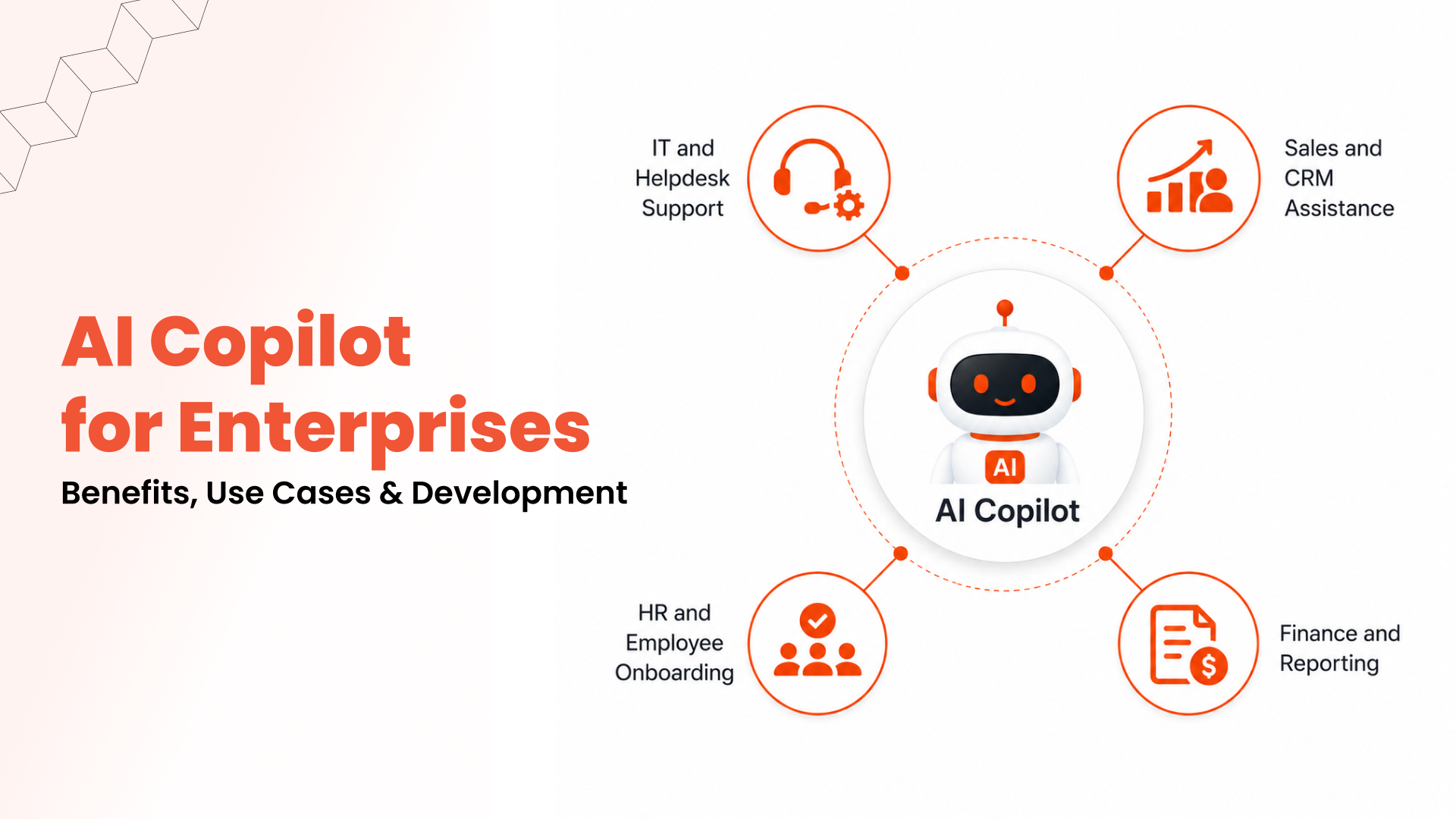
IT and Helpdesk Support
In the Information Industry, there are constantly repetitive requests for password resets, software access, device setups and VPN issues. However, AI Copilot can resolve most of these requests without human interventions
For instance, if for any reason the employee loses access to the project management tool. They can submit the request, and the Copilot will then identify the issue, come up with troubleshooting steps, or raise a ticket automatically with the relevant details.
Sales and CRM Assistance
The sales team in an organization spends hours researching prospects, drafting emails and updating CRM records. Although these tasks are necessary, they relate to non-sales activities. In such a situation, Copilots can help them reduce this overhead.
It can help draft a proposal based on the prospect’s recent LinkedIn activity, surface relevant case studies, or even auto-fill CRM fields after a discovery call.
HR and Employee Onboarding
Whenever someone joins a new organization, they have plenty of questions in their mind, including the company’s rules, policies, benefits, leaves, holidays and processes. But HR Copilot can help them with an instant response without waiting for an HR representative to reply.
For example, if a new employee asks questions like how many sick leaves do I get annually? The Copilot can retrieve information from the organization’s HR policy documents and respond immediately. In a similar way, it helps HR execs and recruiters help them cross-verify the candidate’s profile with the open position to highlight the best fits for the role.
Finance and Reporting
The financial institutions can use AI Copilots to analyze data, pull reports, draft financial summaries and answer compliance questions. They can do these routine tasks faster with fewer errors. For instance, if a finance manager asks for three expense categories from the last quarter. The system retrieves data from ERP and responds with a clear summary.
The time and effort saved can be utilized for strategically building cost-saving initiatives, performing deeper performance analysis and providing nuanced advice to the organization. Rather than wasting time on manual spreadsheet reconciliations, the Copilot helps finance teams act as high-level consultants.
It can even help flag compliance risks for the organizations and highlight budget variance before it becomes a critical issue.
How is AI Copilot Different from AI Agent and AI Chatbot?
The difference between AI Copilot from AI agent and chatbots lies in integration and autonomy. On the one side, AI Copilots work as collaborative assistants that understand context and work alongside the enterprise workflows. AI chatbots are reactive, rule-based assistants best suited for fixed, one-off FAQs.
At the same time, AI agents do not just assist but execute. These systems work independently, planning and completing multi-step tasks with minimal oversight.
AI Chatbot vs AI Copilot vs AI Agent
Conclusion
AI Copilots aren’t just essential for businesses, but something they can’t miss out on. It brings along the core business benefits and fits almost every industrial application. The best part is that they are highly customizable and can be fine-tuned to an enterprise’s specifics.
So by now, you might have understood the potential of AI Copilot for enterprises, and it’s never the best time than today to invest in AI Copilot development. But before that, make sure your decision should depend on business size, budget, technical capabilities and your specific requirements.
To build such an advanced system, undoubtedly, you need experts who know the ins and outs of AI development, just like Mtoag Technologies. With over 17+ years of engineering excellence, we have transformed several enterprises into more agile, efficient, and future-ready organizations by integrating AI-driven solutions that actually deliver results.
FAQs
How to Build an AI Copilot for Enterprises?
Building an AI Copilot starts with identifying clear use cases like support, sales, or reporting. Then comes selecting an LLM, integrating enterprise data, connecting tools like CRM/ERP, and setting governance. A basic version can be built in phases.
What is the Core Architecture of an AI Copilot?
The core architecture includes an LLM layer, a data integration layer, APIs for enterprise tools, and a user interface. It also includes security, access control, and monitoring systems. Together, these components ensure the Copilot understands context and works within business workflows.
How Much Does It Cost to Build an AI Copilot?
The cost depends on complexity and scale. A basic Copilot with limited integrations may cost around $20,000–$50,000. Mid-level solutions can go up to $80,000, while advanced enterprise-grade systems with multiple integrations may exceed $150,000, excluding ongoing maintenance and API usage costs.
How Long Does It Take to Build an AI Copilot?
The development timelines vary based on scope. A simple Copilot can take 6–10 weeks. A moderately complex system may take 3–5 months, while a fully integrated enterprise Copilot can take 6–9 months, including testing, security setup, and deployment across teams.
What are the Challenges in Building Copilots?
The biggest challenges include data privacy, integration with legacy systems, maintaining accuracy, and managing costs. Ensuring proper access control and avoiding incorrect outputs are also critical. Without clear use cases and planning, Copilot implementations can become complex and underutilized.