AI Agents for Businesses: Definition, Use Cases, Types
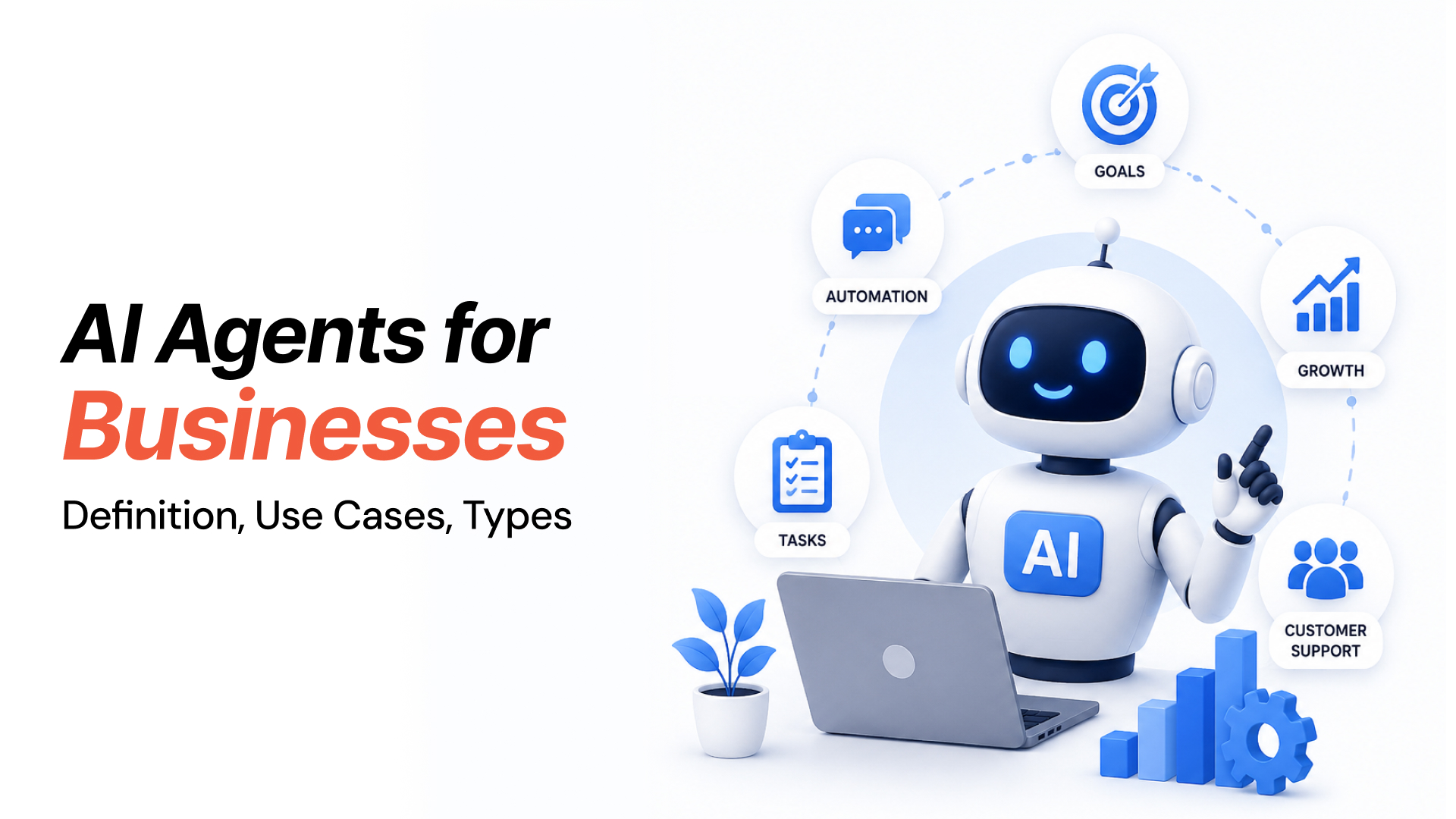
Have you ever thought of having a like-minded assistant to tackle your piling workload? It’s a need every business owner can relate to. If we think about it, a few years ago, this felt difficult to imagine, but today it is a reality with AI agents stepping in as smart assistants.
These AI agents can literally do anything, from automating repetitive tasks, solving complex issues, to providing you with insightful data to suggest informed decisions. Adding more to your surprise, let us tell you that 51% of enterprises are already running AI agents in their production environments.
Let’s not make it more complicated, especially for businesses that are still trying to understand where to start. This guide will help them understand the basics of AI agents, their use cases, types and benefits for enterprises.
Key Takeaways
AI agents are basically software systems powered by artificial Intelligence and machine learning that plan, reason and perform tasks to specific goals.
The global market value of AI agents is estimated at $7.63 billion, which is expected to reach $182.90 billion by 2033, with a CAGR of 49.6%.
85% of businesses and 78% of SMBs are leveraging AI agents, while 90% of them view them as a competitive advantage.
Enterprises using AI agents reported 55% higher efficiency while 35% lower cost. GitHub Copilot users reported 126% faster coding speed.
What are AI Agents?
Artificial Intelligence agents are specialized software systems that act autonomously by understanding The environment, reasoning, planning and taking actions to achieve specific goals without much human intervention.
The AI agents use advanced technologies, such as natural language processing, machine learning, and large language models (LLMs) to analyze the company’s data and make decisions accordingly. Unlike AI assistants or chatbots that are based on predefined rules, AI agents can execute complex and company-specific tasks.
Autonomous AI agents use AI agentic technologies, which let them work independently by sensing The inputs, reasoning and using the external tools. It makes decisions to achieve goals set by human Users. They even learn from past actions to improve performance and adapt to changing conditions.
What are the Components of AI Agent Architecture?
Behind each capable IA agent we see today is a structured architecture that lets them understand, reason and improve over time. Here are the main components AI agents rely on:
Foundation Model: It is an LLM that works as the central part of an agent and serves as its reasoning engine. It helps the agent implement NLP, analyze the context and perform a multi-step reasoning process to generate responses.
Memory Module: It powers up the agents with short and long-term memories so that they retain context, learn from past actions and enhance their performance. Short-term memory saves recent interactions, while long-term memory stores historical data and previous conversations.
Planning Module: It allows agents to break down the complex and large-scale goals into manageable tasks and choose between multiple dependencies to identify the best approach to achieve goals.
Tool Integration: This component connects agents to the enterprise systems, external APIs and software so that they interact with its environment and perform specific tasks.
Governance & Guardrails: These components make sure that operations remain secure and responsible through human-in-the-loop oversight, audit trails and policy-based AI controls.
How Do AI Agents Work?
AI agents work through a continuous sense-plan-act-respond cycle, exactly the same way we humans process information and take actions accordingly. Here’s how AI agents work in detail:
Sense
In the very first step, AI agents receive and understand the information from different sources. Dor this, they may use tools, such as APIs, web scraping, databases or direct data feeds. They then process text, images and data to understand natural language requests. They even collaborate with other agents to exchange information to complete their goals.
Plan
Once an AI agent collects all the required information, it uses algorithms, knowledge bases and internal models to create a plan. Technologies like ML, NLP, Deep Learning and LLMs contribute at this stage. While ML algorithms help agents identify the patterns and make decisions, NLP allow them to understand natural language and textual information. Deep Learning and LLMs let the agents understand the contextual understanding and generate human-like responses.
Act
After that, the AI agents put that plan into action and execute the tasks accordingly. However, the actions may vary depending on the context and the goal. For instance, an AI agent may send notifications, update database records or perform real-time data analysis for better decision making.
Respond
The biggest trait of AI agents is their capabilities to learn, adapt and respond. After an agent performs a task, it gathers the results and the user’s feedback to understand whether the action was successful or not. To improve future performances, these AI constantly update their internal models and knowledge bases. The feedback loop is often driven by reinforcement Learning techniques.
What are the 5 Types of AI Agents?
AI agents are classified into 5 main types based on memory, decision logic, autonomy level and collaboration structure. Let us understand each of the types in brief:
1. Simple Reflex Agents
These are the most basic types of agentic AI that are built to perform simple, pre-defined tasks. They work using the pre-defined rules and execute a pre-programmed action. They consider the current state of the environment and don’t store past experiences and future consequences. They are unable to adapt to unexpected scenarios that go beyond pre-defined ones.
2. Model-based Reflex Agents
Unlike simple reflex agents, these model-based ones use current perception and memory to create an internal model of the environment. These models consider the current state and its evolution, meaning allowing agents to consider past experience and future possibilities when making decisions. They update on new information.
3. Goal-based Agents
These AI agents, as their name suggests, are built to achieve specific goals. They evaluate different options and choose the best path to complete a goal. They are helpful when the end result is known. They don’t need detailed instructions or pre-defined rules to achieve goals.
4. Utility-based Agents
This is one of the most sophisticated AI agents that work beyond just achieving a goal. They assess potential actions to know how well the goal will be achieved by considering The factors, such as cost, risk and efficiency. They choose the actions that come up with the best results.
5. Learning Agents
Learning agents improves its performance over time by analyzing The past interactions and external feedback. They have a learning element that constantly updates their behaviour, a critic that evaluates performance and a problem generator that throws out new actions to try.
Business Benefits of AI Agents
The addition of AI agents to business operations can bring in multiple benefits that mainly include –
Enhanced Efficiency and Productivity
AI agents automate repetitive and time-consuming tasks that would take hours if done by a human employee. These tasks, such as data entry, lead assignments, routine inquiries, or report generation, can easily and efficiently be handled by these AI agents. This frees up humans so they can focus on the core, strategic work that requires unique human skills.
Improved Task Accuracy
AI agents are built to follow the instructions and apply rules accordingly. With accuracy and precision, they reduce human errors in data entry, transaction processing and make decision-making effective. With repetitive tasks, these agents improve the overall accuracy and reliability.
Scalability and 24/7 Availability
Unlike humans, AI agents work 24/7 without any break to sleep, eat or rest. They allow businesses to enhance their efficiency to handle increasing demand without additional staff. With autonomous agents, businesses can work uninterrupted even outside business hours.
Cost Optimization
The task automation, chances of reduced errors and improved efficiency contribute to cost savings for businesses. This includes minimizing expensive errors, reducing labour costs and optimizing resource allocation.
Enhanced Data Analysis
These intelligent AI agents can analyze and process large data sets much faster than traditional systems. These super capabilities of agentic AI allow them to identify trends and patterns to provide actionable insights that empower businesses to make better decisions.
Increased Compliance and Audit Readiness
These AI agents follow pre-defined workflows that help them make sure the regulatory processes execute efficiently and without interruptions. They can even generate audit trails and clear logs to make it easier for organizations to show compliance.
Improved Customer Experiences
The best part about integrating AI agents is that they support customer service professionals by helping Them with instant responses to common queries and routing complex issues to the right executive. This helps customer support teams to resolve issues more efficiently, faster and improve overall customer experience.
Real-Life Use-cases of AI Agents
AI agents have started dominating the major industry and have proved to be a boon for them. Here’s how they are fitting into different industrial use cases.
Customer Support Automation
AI agents are being deployed as intelligent customer support executives or virtual assistants to manage customer queries. These agents not only reply faster but also resolve basic issues and perform simple tasks on behalf of clients, including checking order status. The addition of agents to customer support processes helps businesses improve response time and achieve customer satisfaction.
Marketing Automation
AI in marketing has transformed a lot with the addition of agentic AI. They help marketing professionals in segmenting audiences, creating personalized content and triggering multi-step email marketing campaigns based on user behaviour. And the best part is that everything is automated. For instance, an autonomous agent can automatically send follow-up emails after webinar registration or adjust the ad budget based on the campaign budget.
Intelligent Meeting Scheduling
AI agents can automatically schedule meetings with clients by synchronizing Multiple calendars, time zones, and preferences. They find an optimal time slot that fits within all participants' schedules, automatically send invites and update calendars. These agents can even reschedule the meeting if it's postponed. They can update the CS records with meeting details and outcomes.
Dynamic Product Recommendation
E-commerce businesses are one of the few industries taking full advantage of agentic AI. They can use autonomous agents to automatically generate and display product recommendations based on customer preference, shopping patterns, online activity and shopping cart. These agents gather new data and update their recommendations in real time to the customer’s current needs.
Industry-specific Use Cases
According to Markets and Markets research, the industry -specific AI agents adoption is likely to increase by over 35% in the next 5 years. This includes the major industries like finance, healthcare, legal, manufacturing and marketing.
Here are some industry-specific use cases of AI agents:
Healthcare: AI agents can help healthcare professionals and support staff to automate appointments, patient visit scheduling, medical record updation and insurance claims processing.
Finance: Financial institutions are increasingly adopting AI agents to automate the credit scoring, regulatory compliance checks, and detect fraud by recurring Patterns.
Manufacturing: AI agents can help manufacturing units to monitor equipment performance over time, manage inventory and optimize the supply chains.
Conclusion
Unlike tradition Ai systems and chatbots, modern AI agents are much more capable of analyzing context, accessing external tools, performing specific tasks and continuously improving their performance. With such advanced systems and plenty of business benefits, enterprises are increasingly investing in AI agent development services to improve efficiency, automate processes and enhance customer experiences.
AI development companies such as Mtoag Technologies make it easier to develop and deploy AI agents for enterprises. With built-in integrations, governance and orchestration capabilities, businesses can safely adopt agentic AI and experience the measurable outcomes in sales, service and operations.
FAQs
Is ChatGPT an AI Agent?
No, ChatGPT is not an AI agent but a language model that can mimic agent-like behaviour, but real AI agents need autonomy, memory, planning and the ability to take independent actions.